
Tag: #Uncertain/Imprecise Labels
Environmentally-Adaptive Target Recognition for SAS Imagery
March 17, 2017Abstract: Characteristics of underwater targets displayed in synthetic aperture sonar (SAS) imagery vary depending on their environmental context. Discriminative features in sea grass may differ from the features that are discriminative in sand ripple, for example. Environmentally-adaptive target detection and classification systems that take into account environmental context, therefore, have the potential for improved results. […]
Read more: Environmentally-Adaptive Target Recognition for SAS Imagery »Hyperspectral Unmixing with Endmember Variability using Semi-supervised Partial Membership Latent Dirichlet Allocation
March 17, 2017Abstract: A semi-supervised Partial Membership Latent Dirichlet Allocation approach is developed for hyperspectral unmixing and endmember estimation while accounting for spectral variability and spatial information. Partial Membership Latent Dirichlet Allocation is an effective approach for spectral unmixing while representing spectral variability and leveraging spatial information. In this work, we extend Partial Membership Latent Dirichlet Allocation […]
Read more: Hyperspectral Unmixing with Endmember Variability using Semi-supervised Partial Membership Latent Dirichlet Allocation »Map-guided Hyperspectral Image Superpixel Segmentation Using Proportion Maps
January 10, 2017Abstract: A map-guided superpixel segmentation method for hyperspectral imagery is developed and introduced. The proposed approach develops a hyperspectral-appropriate version of the SLIC superpixel segmentation algorithm, leverages map information to guide segmentation, and incorporates the semi-supervised Partial Membership Latent Dirichlet Allocation (sPM-LDA) to obtain a final superpixel segmentation. The proposed method is applied to two […]
Read more: Map-guided Hyperspectral Image Superpixel Segmentation Using Proportion Maps »Multiple Instance Hybrid Estimator for Learning Target Signatures
January 10, 2017Abstract: Signature-based detectors for hyperspectral target detection rely on knowing the specific target signature in advance. However, target signature are often difficult or impossible to obtain. Furthermore, common methods for obtaining target signatures, such as from laboratory measurements or manual selection from an image scene, usually do not capture the discriminative features of target class. […]
Read more: Multiple Instance Hybrid Estimator for Learning Target Signatures »Map-guided Hyperspectral Image Superpixel Segmentation Using Semi-supervised Partial Membership Latent Dirichlet Allocation
December 20, 2016Abstract: Many superpixel segmentation algorithms which are suitable for the regular color images like images with three channels: red, green and blue (RGB images) have been developed in the literature. However, because of the high dimensionality of hyperspectral imagery, these regular superpixel segmentation algorithms often do not perform well in hyperspectral imagery. Although there are […]
Read more: Map-guided Hyperspectral Image Superpixel Segmentation Using Semi-supervised Partial Membership Latent Dirichlet Allocation »Semi-supervised Interactive Unmixing for Hyperspectral Image Analysis
December 20, 2016Abstract: In the past several decades, hyperspectral imaging has drawn a lot of attention in the eld of remote sensing. Yet, due to low spatial resolutions of hyperspectral imagers, often the response from more than one surface material can be found in some hyperspectral pixels. These pixels are called mixed pixels. Mixed pixels bring challenges […]
Read more: Semi-supervised Interactive Unmixing for Hyperspectral Image Analysis »Hyperspectral Unmixing with Endmember Variability Using Partial Membership Latent Dirichlet Allocation
September 13, 2016Abstract: The application of Partial Membership Latent Dirichlet Allocation (PM-LDA) for hyperspectral endmember estimation and spectral unmixing is presented. PM-LDA provides a model for a hyperspectral image analysis that accounts for spectral variability and incorporates spatial information through the use of superpixel-based ”documents”. In our application of PM-LDA, we employ the Normal Compositional Model in […]
Read more: Hyperspectral Unmixing with Endmember Variability Using Partial Membership Latent Dirichlet Allocation »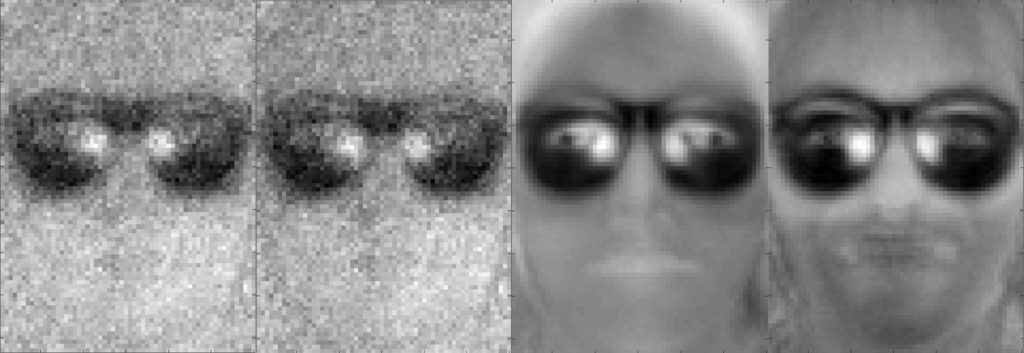
Discriminative Multiple Instance Hyperspectral Target Characterization
September 11, 2016Abstract: In this paper, two methods for multiple instance target characterization, MI-SMF and MI-ACE, are presented. MI-SMF and MI-ACE estimate a discriminative target signature from imprecisely-labeled and mixed training data. In many applications, such as sub-pixel target detection in remotely-sensed hyperspectral imagery, accurate pixel-level labels on training data is often unavailable and infeasible to obtain. […]
Read more: Discriminative Multiple Instance Hyperspectral Target Characterization »Multiple Instance Dictionary Learning using Functions of Multiple Instances
September 11, 2016Abstract: A multiple instance dictionary learning method using functions of multiple instances (DL-FUMI) is proposed to address target detection and two-class classification problems with inaccurate training labels. Given inaccurate training labels, DL-FUMI learns a set of target dictionary atoms that describe the most distinctive and representative features of the true positive class as well as […]
Read more: Multiple Instance Dictionary Learning using Functions of Multiple Instances »Heart Beat Characterization from Ballistocardiogram Signals using Extended Functions of Multiple Instances
August 11, 2016Abstract: A multiple instance learning (MIL) method, extended Function of Multiple Instances (eFUMI), is applied to ballistocardiogram (BCG) signals produced by a hydraulic bed sensor. The goal of this approach is to learn a personalized heartbeat ”concept” for an individual. This heartbeat concept is a prototype (or ”signature”) that characterizes the heartbeat pattern for an […]
Read more: Heart Beat Characterization from Ballistocardiogram Signals using Extended Functions of Multiple Instances »