
Category: Journal Papers
A novel multi-perspective imaging platform (M-PIP) for phenotyping soybean root crowns in the field increases throughput and separation ability of genotype root properties
May 3, 2018Abstract: Background: Root crown phenotyping has linked root properties to shoot mass, nutrient uptake, and yield in the field, which increases the understanding of soil resource acquisition and presents opportunities for breeding. The original methods using manual measurements have been largely supplanted by image-based approaches. However, most image-based systems have been limited to one or […]
Read more: A novel multi-perspective imaging platform (M-PIP) for phenotyping soybean root crowns in the field increases throughput and separation ability of genotype root properties »Multi-Resolution Multi-Modal Sensor Fusion For Remote Sensing Data With Label Uncertainty
May 3, 2018Abstract: In remote sensing, each sensor can provide complementary or reinforcing information. It is valuable to fuse outputs from multiple sensors to boost overall performance. Previous supervised fusion methods often require accurate labels for each pixel in the training data. However, in many remote sensing applications, pixel-level labels are difficult or infeasible to obtain. In […]
Read more: Multi-Resolution Multi-Modal Sensor Fusion For Remote Sensing Data With Label Uncertainty »Multiple Instance Choquet Integral Classifier Fusion and Regression for Remote Sensing Applications
March 13, 2018Abstract: In classifier (or regression) fusion the aim is to combine the outputs of several algorithms to boost overall performance. Standard supervised fusion algorithms often require accurate and precise training labels. However, accurate labels may be difficult to obtain in many remote sensing applications. This paper proposes novel classification and regression fusion models that can […]
Read more: Multiple Instance Choquet Integral Classifier Fusion and Regression for Remote Sensing Applications »Multiple Instance Hybrid Estimator for Hyperspectral Target Characterization and Sub-pixel Target Detection
October 31, 2017Abstract: The Multiple Instance Hybrid Estimator for discriminative target characterization from imprecisely labeled hyperspectral data is presented. In many hyperspectral target detection problems, acquiring accurately labeled training data is difficult. Furthermore, each pixel containing target is likely to be a mixture of both target and non-target signatures (i.e. sub-pixel targets), making extracting a pure prototype […]
Read more: Multiple Instance Hybrid Estimator for Hyperspectral Target Characterization and Sub-pixel Target Detection »
Multiple Instance Dictionary Learning for Beat-to-Beat Heart Rate Monitoring from Ballistocardiograms
June 15, 2017Abstract: A multiple instance dictionary learning approach, Dictionary Learning using Functions of Multiple Instances (DLFUMI), is used to perform beat-to-beat heart rate estimation and to characterize heartbeat signatures from ballistocardiogram (BCG) signals collected with a hydraulic bed sensor. DL-FUMI estimates a “heartbeat concept” that represents an individual’s personal ballistocardiogram heartbeat pattern. DL-FUMI formulates heartbeat detection […]
Read more: Multiple Instance Dictionary Learning for Beat-to-Beat Heart Rate Monitoring from Ballistocardiograms »Measures of the Shapley index for learning lower complexity fuzzy integrals
June 12, 2017Abstract: The fuzzy integral (FI) is used frequently as a parametric nonlinear aggregation operator for data or information fusion. To date, numerous data-driven algorithms have been put forth to learn the FI for tasks like signal and image processing, multi-criteria decision making, logistic regression and minimization of the sum of squared error (SEE) criteria in […]
Read more: Measures of the Shapley index for learning lower complexity fuzzy integrals »
Partial Membership Latent Dirichlet Allocation for Soft Image Segmentation
December 28, 2016Abstract: Topic models (e.g., pLSA, LDA, sLDA) have been widely used for segmenting imagery. However, these models are confined to crisp segmentation, forcing a visual word (i.e., an image patch) to belong to one and only one topic. Yet, there are many images in which some regions cannot be assigned a crisp categorical label (e.g., […]
Read more: Partial Membership Latent Dirichlet Allocation for Soft Image Segmentation »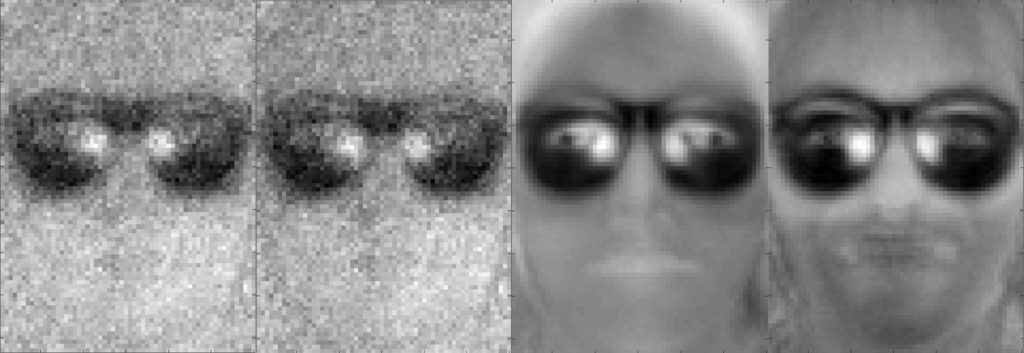
Discriminative Multiple Instance Hyperspectral Target Characterization
September 11, 2016Abstract: In this paper, two methods for multiple instance target characterization, MI-SMF and MI-ACE, are presented. MI-SMF and MI-ACE estimate a discriminative target signature from imprecisely-labeled and mixed training data. In many applications, such as sub-pixel target detection in remotely-sensed hyperspectral imagery, accurate pixel-level labels on training data is often unavailable and infeasible to obtain. […]
Read more: Discriminative Multiple Instance Hyperspectral Target Characterization »Hyperspectral Unmixing With Endmember Variability via Alternating Angle Minimization
August 11, 2016Abstract: In hyperspectral unmixing applications, one typically assumes that a single spectrum exists for every endmember. In many scenarios, this is not the case, and one requires a set or a distribution of spectra to represent an endmember or class. This inherent spectral variability can pose severe difficulties in classical unmixing approaches. In this paper, […]
Read more: Hyperspectral Unmixing With Endmember Variability via Alternating Angle Minimization »
Sand ripple characterization using an extended synthetic aperture sonar model and parallel sampling method
October 11, 2015Abstract: The aim of this work is to characterize the seafloor by estimating invariant sand ripple parameters from synthetic aperture sonar (SAS) imagery. Using a hierarchical Bayesian framework and a known sensing geometry, a method for estimating sand ripple frequency, amplitude, and orientation values from a single SAS image, as well as from sets of […]
Read more: Sand ripple characterization using an extended synthetic aperture sonar model and parallel sampling method »