
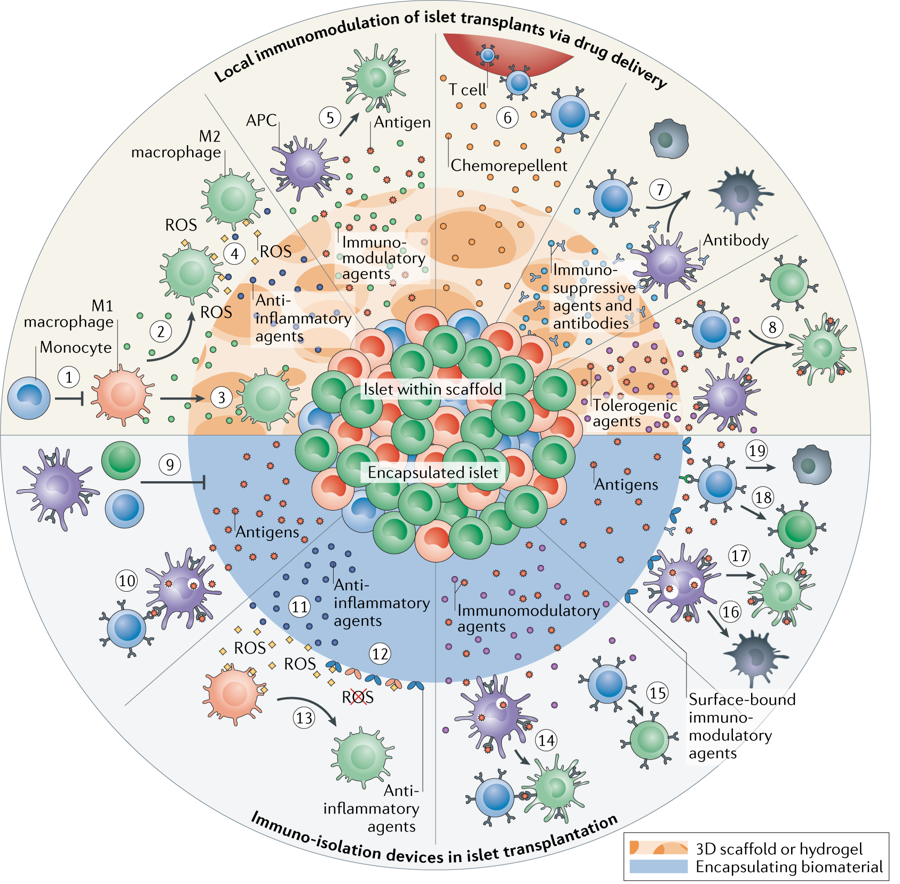
One of the biggest challenges to the clinical success of allogeneic transplants is the interaction between the host immune system and foreign transplanted cells. The human immune system consists of the innate and adaptive immune systems, both highly potent, in which each branch plays a particular role in combating disease and infection. In the context of biomaterials, poorly biocompatible implants result in an aggressive foreign body reaction that is mediated largely by innate immunity. For tissue-engineered implants containing cells, however, both innate and adaptive immunity play large roles. Innate provides a generalized response to the material and trauma associated with implantation, while adaptive immunity is triggered by the foreign antigens presented by the cells. Further, the role of adaptive immunity in biomaterials has recently been of interest, as antibodies to materials themselves have been uncovered.
As such, for implants containing cells and biomaterials, controlling immunological response to the implant is of utmost importance to permit healthy acceptance of the foreign implant. While biomaterials may be able to shield direct antigen recognition of the foreign cells, indirect antigen presentation still occurs. The use of biologically active agents that can combat immunological responses to the graft could serve to promote cell survival. These agents could be injected systemically or localized via the use of biomaterials. Biomaterials may release these agents in a drug-delivery platform or present these agents on their surface.
In our laboratory, we are addressing this challenge through multiple avenues:
- Designing polymers for cell surface grafting: This allows for the masking of cell surface antigens that instigate immune attack. Through this effort, we are leveraging a diverse toolset of polymers and reactive groups, from PEG and alginate, to Staudinger ligation.
- Local drug delivery at implant site: We are engineering biomaterials that locally release immunomodulatory agents in an effort to decrease systemic burden. Through using novel immunosuppressive agents, we can induce a more local and nuanced effect that can direct host responses towards more favorable outcomes. Using an engineering approach, we can modulate deliver rates and release multiple drugs for a combinatory effect.
- Tolerance-inducing biomaterials: Using our functionalized biomaterials, we can bind specific agents, such as antibodies, proteins, and/or nanoparticles, to provide more nuanced cues to recruited immune cells, thereby directing their phenotype towards a more tolerogenic response. A key goal of this approach is to drive immune-instruction, as opposed to suppression, in order to induce a more durable effect.
Check out our recent reviews for an overview of this topic:
- Engineering immunomodulatory biomaterials for type 1 diabetes
Published in Nature Reviews Materials - Immunoprotection of cellular transplants for autoimmune type 1 diabetes through local drug delivery
Published in the Adv Drug Delivery Reviews - Encapsulated islet transplantation published in Nature Reviews Bioengineering
- Designing biomaterials for the modulation of allogeneic and autoimmune responses to cellular implants in type 1 diabetes published in Acta Biomaterialia
Check out our recent research articles on this topic:
- Antioxidant Cerium Oxide Nanoparticle Coatings Impart Immunomodulatory Effects by Suppressing Antigen‐Specific Cytotoxic T Cell Activation published in JBMR A
- In vitro platform establishes antigen-specific CD8+ T cell cytotoxicity to encapsulated cells via indirect antigen recognition published in Biomaterials
- Immunosuppressive PLGA TGF-β1 microparticles induce polyclonal and antigen-specific regulatory T cells for local immunomodulation of allogeneic islet transplants published in Front of Immunology
- Local release of dexamethasone from macroporous scaffolds accelerates islet transplant engraftment by promotion of anti-inflammatory M2 macrophages published in Biomaterials
Research in this area supported by:
NIH NIDDK R01 and NIH NIDDK T1D Pathfinder