
Project Overview
Autonomous aerial systems must continue to perceive motion when illumination is poor, visual noise is high, and conventional cameras provide limited detail. This research develops bio-inspired event-vision pipelines that expose useful motion cues while avoiding expensive enhancement of every pixel.
ASTEF established the region-based foundation: it divides a frame into 8 × 8 regions, selectively enhances dark areas, and uses adaptive thresholds and temporal filtering to generate sparse events. The subsequent ASAP 2025 system extends this idea into a unified KV260 pipeline that combines neuromorphic preprocessing with a compact, quantized small-object detector.
System Approach
- Event simulation: Conventional RGB frames are converted into sparse, motion-sensitive event representations.
- Regional enhancement: Illumination-aware processing enhances only low-light regions and suppresses redundant activity.
- Small-object detection: A seven-stage, INT8 detector uses depthwise separable convolutions for efficient aerial-object inference.
- Hardware/software co-design: Neuromorphic preprocessing runs in the KV260 programmable logic, while detection runs on its quad-core Arm processor through AXI and shared DDR buffers.
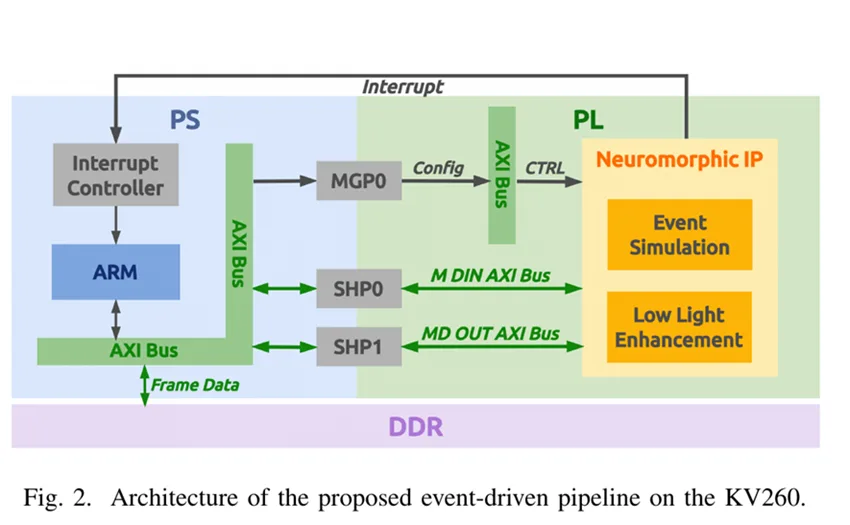
Editor note – Caption: Unified KV260 pipeline for bio-inspired preprocessing and compact detection. Alt text: Block diagram of the KV260 hardware/software pipeline. RGB frames enter through the Arm processing system and DDR; the programmable logic performs event simulation and regional low-light enhancement; enhanced data returns through AXI for compact small-object detection.
Experimental Results
- ASTEF on Zynq-7000: 10,045 LUTs, 14,224 flip-flops, 112.5 BRAMs, and 2.096 W. Relative to HMAX, it reduces LUT use by 83.91%, flip-flop use by 40.59%, BRAM use by 29.25%, and power by 83.88%.
- KV260 preprocessing: 7,871 LUTs, 7,797 registers, 4 BRAMs, 54 DSPs, and 2.606 W, with reported FPGA processing at 5-6 FPS for 640 × 480 input.
- Low-light enhancement: Compared with FOLD, the unified system reports 14% lower MSE, 4.5% higher PSNR, and 7.1% higher SSIM.
- Compact detector: The INT8 model requires 1.1 MMACs and 42,712 parameters, with a 7.05% accuracy reduction from its floating-point baseline.
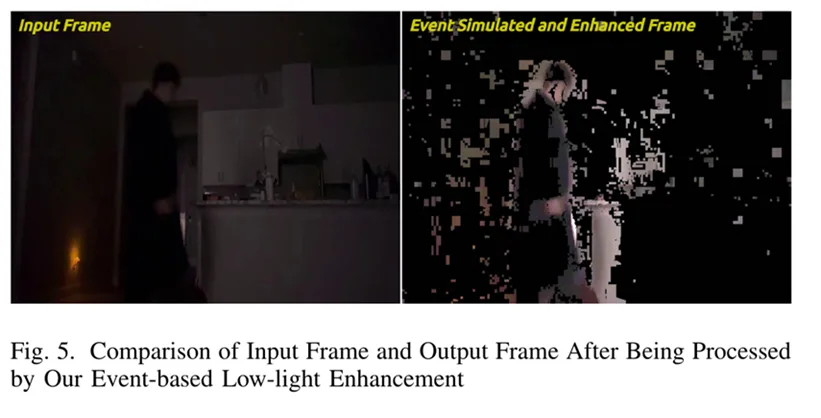
Editor note – Caption: Low-light input and event-simulated enhanced output. Alt text: Side-by-side frames show a dark outdoor scene as the input and the same scene after event-guided enhancement, where illuminated structures and foreground details are more visible.
Impact
Together, these systems provide an efficient front end for UAV detection, tracking, navigation, and later semantic reasoning in poorly illuminated environments. They demonstrate how selective enhancement and heterogeneous edge computing can preserve useful visual information without relying on cloud processing.
Publications
Z. Wang, P. Mbua, and C. Bobda, “ASTEF: FPGA-Based Enhancement of Event Camera Performance in Low-Light Conditions,” 2025 IEEE 33rd Annual International Symposium on Field-Programmable Custom Computing Machines (FCCM), p. 284, 2025. DOI: 10.1109/FCCM62733.2025.00056.
Z. Wang, W. A. Fortney, and C. Bobda, “Bio-Inspired Event Cameras for Robust Edge System in Challenging Environments,” 2025 IEEE 36th International Conference on Application-specific Systems, Architectures and Processors (ASAP), pp. 131-138, 2025. DOI: 10.1109/ASAP65064.2025.00030.