
By Muriel Medard (Massachusetts Institute of Technology)
Talk Abstract: Traditional computing follows the von Neumann architecture, where a compute/control unit interacts with read/write memory via a bus. Compute/control relies crucially on memory and access to it. This model has underpinned decades of innovation.
Web3 has traditionally developed technologies such as virtual machines (VMs), that map onto von Neumann’s compute/control framework. Data propagation (bus) and access (read/write memory), however, have emerged as present critical constraints in decentralized environments.
Unlike Web2, which benefits from powerful abstractions such as the TCP/IP socket to enable seamless end-to-end data transport in a decentralized network, Web3 lacks an equivalent mechanism for data propagation and access across decentralized nodes.
We introduce a breakthrough in Web3 infrastructure by using Optimum P2P for data propagation and decentralized random access memory (DeRAM) for data read/writes. Optimum acts as a virtualized dedicated memory layer, enabling high-speed data propagation, secure access, and real-time updates over a permissionless, decentralized, and potentially unreliable network of nodes. By leveraging Random Linear Network Coding (RLNC), Optimum ensures atomic, consistent, and durable data access, while maintaining high throughput and low latency.
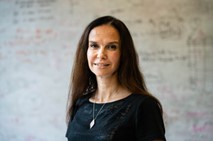 Speaker Bio: Muriel Médard is the co-founder of Optimum, on leave from MIT, where she holds the NEC Chair of Software Science and Engineering for the School of Engineering at MIT, and is a Professor in EECS. She obtained three Bachelors degrees, her M.S. and Sc.D, all from MIT. Muriel is a Member of the US National Academy of Engineering (elected 2020), a Member of the German National Academy of Sciences Leopoldina (elected 2022), a Fellow of the US National Academy of Inventors (elected 2018), American Academy of Arts and Sciences (elected 2021), and a Fellow of the Institute of Electrical and Electronics Engineers (elected 2008). She holds Honorary Doctorates from the Technical University of Munich (2020), the University of Aalborg (2022) and the Budapest University of Technology and Economics (2023). Muriel was awarded the 2022 IEEE Kobayashi Computers and Communications Award. She has received multiple best paper award, including the Sigcomm 2018 Test of Time Award. Muriel served as the Editor-in-Chief (EIC) of IEEE Transactions on Information Theory, and was EiC of IEEE JSAC. She was president of the IEEE Information Theory Society. Muriel received the inaugural MIT Postdoctoral Association Mentoring Award in 2022, the inaugural MIT EECS Graduate Student Association Mentor Award, voted by the students, in 2013. She set up the Women in the Information Theory Society (WithITS) and Information Theory Society Mentoring Program. She was recognized with the 2017 IEEE Aaron Wyner Distinguished Service Award. Muriel has over seventy US and international patents awarded, the vast majority of which have been licensed or acquired. Muriel has supervised over 40 master students, over 20 doctoral students and over 25 postdoctoral fellows.