
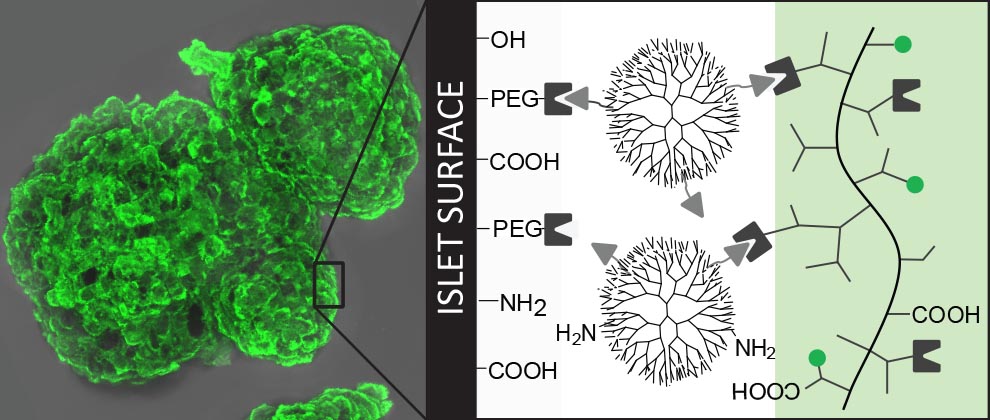
The encapsulation/immunoisolation of cells has numerous applications in cellular transplantation, particularly for diabetes. Conventional encapsulation methods impose consequential mass transport limitations and transplant volumes. New approaches, such as layer-by-layer encapsulation, generate ultrathin coatings, but common challenges include incomplete encapsulation, coating stability, and method cytotoxicity.
In our patented approach, we have used functionalized polymers capable of forming stable, covalent linkages via Staudinger ligation—a spontaneous, chemoselective, and cell-compatible reaction. We have subsequently explored the use of these complementary PEG- and alginate-based polymers to fabricate covalently linked, nano-thick coatings on cellular spheroids, particularly islets. We have found these coatings to be highly cell compatible, with no impairment of glucose responsiveness.
Once coated, these polymers can also serve as a platform for the tethering of additional agents, which would subsequently serve to instruct the surrounding host environment or support islet engraftment.