
Category: Featured
Home page slider featured posts
Percolation transport in nanostructure networks
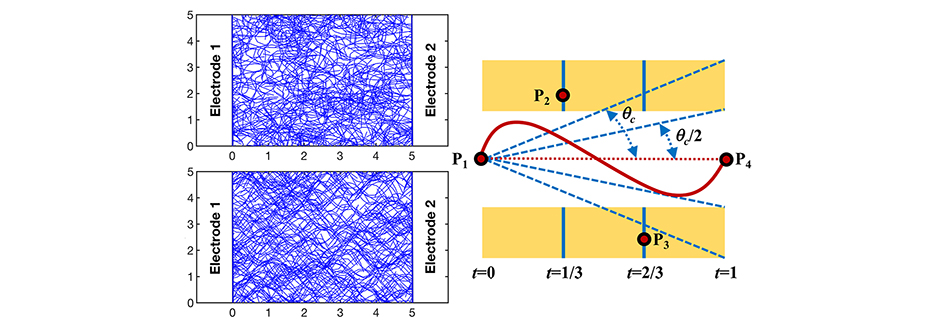
June 5, 2018Percolation transport in nanostructure networks Percolation transport deals with the formation of long-range connectivity in random networks. Our recent work on the effect of nanowire curviness on the percolation resistivity of transparent, conductive metal nanowire networks, where we studied the interaction between curviness and other nanowire/device parameters, has been highlighted in AIP Scilight. Scilights showcase the […]
Read more: Percolation transport in nanostructure networks »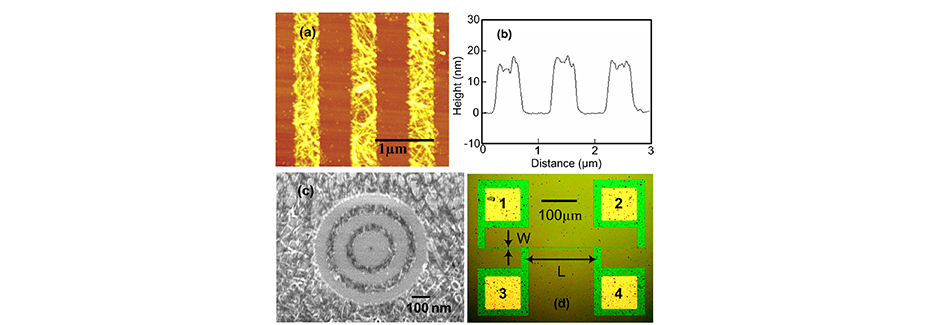
Transparent electrodes
June 12, 2016Transparent, conductive, and flexible electrodes based on carbon nanotubes and graphene Carbon nanomaterials, such as carbon nanotube (CNT) films and graphene exhibit good electrical conductivity, high optical transparency, and mechanical flexibility. As a result, they are excellent candidates for next generation transparent, conductive, and flexible electrodes for applications such as touch screens, electronic paper, LEDs, photodetectors, and […]
Read more: Transparent electrodes »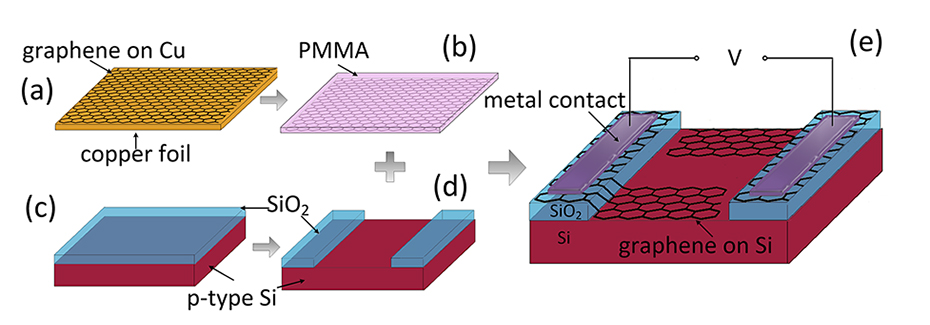
Heterojunctions
June 12, 2016Mixed-dimensional van der Waals Schottky junctions between nanomaterials and conventional semiconductors For most device applications of nanomaterials, interfaces and junctions play a significant role. Mixed-dimensional van der Waals heterojunctions are formed by stacking materials with different dimensionality through non-covalent van der Waals interactions. Heterojunctions between nanomaterials and conventional semiconductors combine the advantages of new nanoscale materials with […]
Read more: Heterojunctions »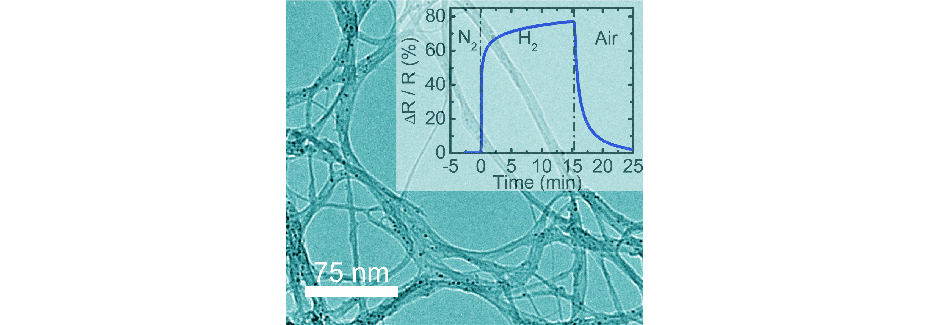
Molecular Sensing
June 10, 2016Nanoscale molecular sensors Nanoscale materials have naturally small size, extremely high surface-to-volume ratio, low noise, and low-power consumption. As a result of these significant advantages, they are excellent candidates for molecular gas and vapor sensors. Furthermore, selectivity to different gas molecules can be achieved by surface functionalization. (Read sample publication)
Read more: Molecular Sensing »