
My research program works to design new environmentally-friendly cementitious materials and quantify how concrete materials perform during construction and use. Work is under way to develop new materials for concrete that are more durable, environmentally friendly, and lower cost than concrete containing only portland cement.
Current Topics
Concrete Transport Properties

Corrosion of reinforcing steel in concrete is most often caused by chlorides that penetrate into the porous concrete. Research is underway to determine how to best measure the concrete’s resistance to chloride penetration in extremely aggressive environments for use in quality control applications. As part of this work and to link concrete laboratory tests and field performance, we have established a concrete field exposure site at Seahorse Key, FL.
Ultra-High-Performance Concrete
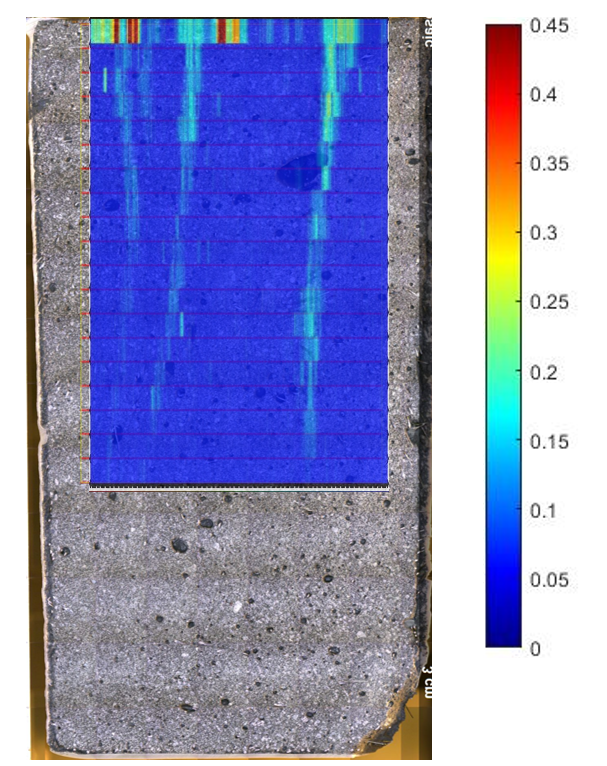
Ultra-high-performance concrete has the potential to significantly improve concrete durability, especially in marine environments. We are currently working with Florida State University and the Florida Department of Transportation on determining the ability for cracks in ultra-high-performance concrete to self-heal.
Mechanochemical Activation of Recycled Materials
Mechanochemical activation uses high-energy milling to chemically activate materials, and in some cases make them reactive enough for use as a supplementary cementitious material in concrete. We are examining the ability of mechanochemical activation to activate some recycled materials for use in concrete.
Alternative Supplementary Cementitious Material Use in Concrete
Supplementary cementitious materials (SCMs) are often used in concrete to improve concrete strength and durability. Fly ash has been the dominant SCM used in North America for the last 50 years. Research is being conducted to understand and quantify the durability of concrete made with alternative sources of SCMs. These alternative SCMs being investigated include impounded fly ash, sugarcane bagasse, and calcined clay.