Earlier this summer, the Coastal and Marine Geotechnics team collected preliminary geotechnical data using our Free Fall Penetrometer (BlueDrop) in the Hudson River, with none other than Lady Liberty herself in view!
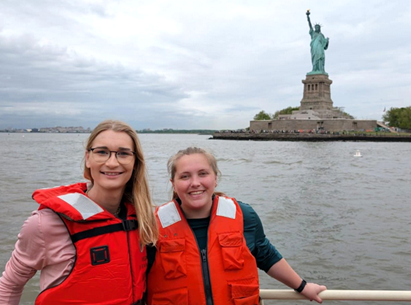
UF Research Coordinator Charlie Pezoldt and graduate student Jaq Mueller (left to right). Photo credit: Jaq Mueller.
The team joined a multi-institutional effort to study sediment conditions in the Hudson River as part of a broader study led by the U.S. Army Corps of Engineers North Atlantic Division (NAN), the U.S. Army Engineer Research and Development Center (ERDC), and assisted by additional industry collaborators. This effort aims to support the development of national guidelines for appropriate burial depths of submarine cables and pipelines in active navigation channels.
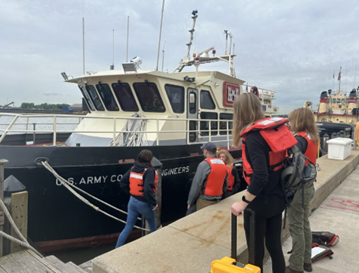
Field crew boarding the U.S. Army Corps of Engineers vessel. Photo credit: Jaq Mueller.
With anchor and vessel-related strikes on buried infrastructure becoming more frequent, defining safe, site-specific burial depths is increasingly critical. Traditional guidelines often overlook local sediment conditions, leaving buried infrastructure vulnerable to dredging, anchor drag, and other hazards. This study aims to fill that knowledge gap using real-world data from a major U.S. waterway. The University of Florida team is contributing geotechnical expertise and in-situ data collection to assess sediment strength and spatial variability across the Hudson River.
The University of Florida team included graduate student Jaq Mueller and research coordinator Charli Pezoldt. Sediment conditions were measured using a Portable Free Fall Penetrometer (PFFP), which measured embedment depth, deceleration, and undrained shear strength at various locations inside and outside the Hudson’s main navigation channel. Results showed that sediment strength varied widely, with most areas considered to have softer sediment, while several deployment sites revealed stronger or possibly obstructed sediment. This may reflect rock forms, trash, or debris in the sediment bed, unsurprising given the Hudson’s long history as a commercial waterway dating back centuries.

UF Research Coordinator Charli Pezoldt guides the Portable Free Fall Penetrometer (BlueDrop), used to collect measurements of sediment conditions. Photo credit: Jaq Mueller.
A second field campaign is planned for fall 2025, expanding the dataset with sediment cores and additional instruments. Keep an eye out as this important work unfolds, maybe with Lady Liberty making a cameo once again!