
My Primary Interests are in Analog, Mixed-Signal, RF and Digital VLSI Design for Sensing, Clocking, Analytics and Communication for Biomedical Applications. My broader interests include Device-Circuit co-design, Computer Architecture and Algorithms, Internet of Things, Bio-Sensors and Bio-MEMS.
Projects I’m Currently Involved in:
Medical Wearables and Implants for Closed-loop Internet of Bodies (IoB)
Funding Acknowledgement and Thanks: National Science Foundation – NSF CAREER Award ECCS #2441610
This work focuses on the design and development of Closed-loop Medical Wearables and Implants for the Internet of Bodies (IoB).
Center for Internet of Bodies: Center for IoB is a multi-university center that focuses on the research on sensing, analytics, communication, actuation, powering and harvesting around the human body.
Our vision for IoB is Explained in this Annual Review of Biomedical Engineering (2023 Impact Factor: 11.324) Article, where the challenges and opportunities in this research area are articulated, in terms of sensing, processing, communication, powering and security of IoB nodes. The specific use-cases of Human-Body Communication (HBC) are also explained for IoB, as a differentiating factor from Wireless Body-Area Network (WBAN).
More details on IoB can be found in this infographic and this blog post. Bioelectronic sensor nodes (which can be either wearable or implantable) can harness the power of distributed internet of bodies to perform closed-loop tasks such as neuromodulation. We explore fundamental challenges and limits of various energy harvesting, sensing and communication techniques that are suitable for IoB platforms. In-sensor analysis powered by efficient computing methods as well as Custom modulation techniques are also being explored.
Collaborators: Prof. Shreyas Sen – Purdue University, Prof. Adam Khalifa – University of Florida, Prof. Shriya Srinivasan – Harvard University, Prof. Jack Judy – University of Florida
Publications: Nature Electronics 2023; Annual Reviews of Biomedical Engineering 2023; BioCAS 2024; TBioCAS 2025; ISCAS 2024; EMBC 2024; EMBC 2024; ISCAS 2025; MWSCAS 2025; MAPCon 2025; CICC 2026; CICC 2026.
Graduate Students working on the Project:
ENCASE: Hardware-Software Co-design of Electromagnetics, Nanomaterials, Circuits and Architectures for Security against Side-channel Emanation
Funding Acknowledgement and Thanks: National Science Foundation (NSF) CNS #2343128
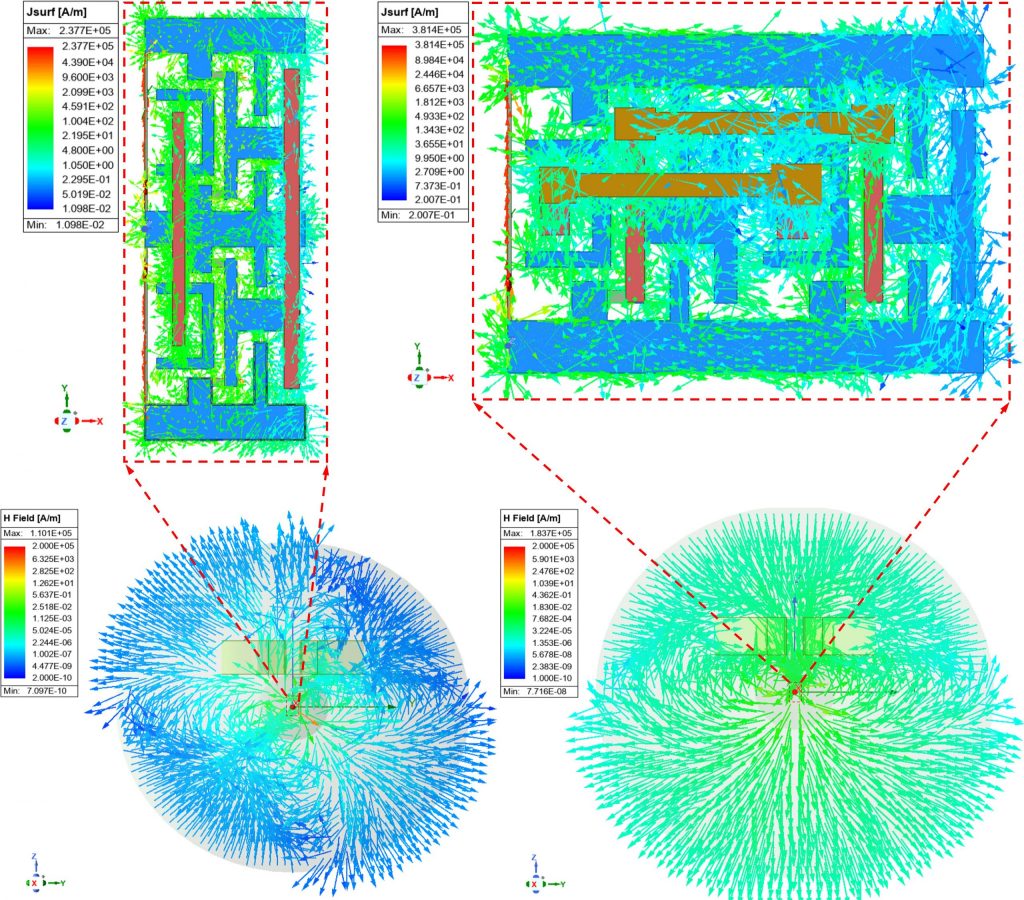
This project targets targets developing a hardware-software co-design approach at different abstraction levels, including EM analysis, Circuit/Logic, and Layout, as well as Architectural/System Design that helps ‘encase’-ing the physical hardware with respect to the EM and power side channels (EMPSC).
Further details can be found here.
Collaborators: Prof. Debayan Das – Indian Institute of Science
Publications: MWSCAS 2025
Graduate Students working on the Project:

S4OR H6: Timing is Everything: Ultra-Stable Temperature and Aging Compensated Clock
Funding Acknowledgement and Thanks: Defense Advanced Research Projects Agency (DARPA) H6 program under Contract No. HR00112390018
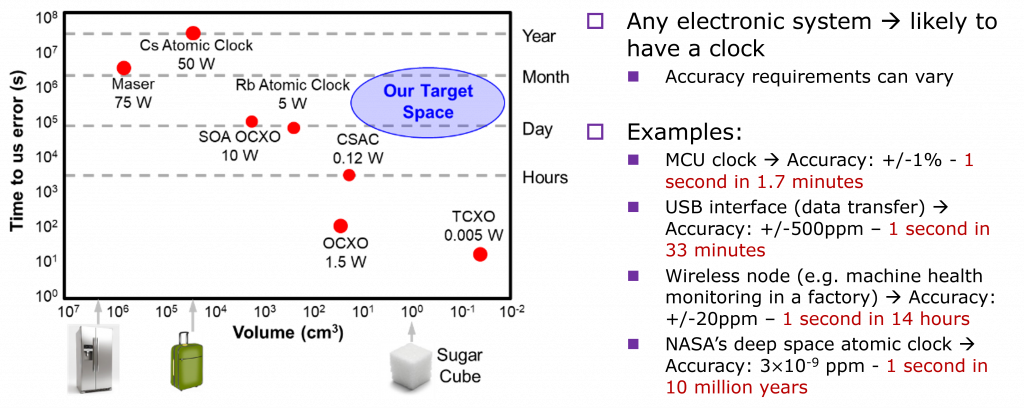
This work aims to develop extremely stable (<1μs error in a week, <100ns error in a day) clocks in a wearable form-factor, using suitable temperature and aging compensation mechanisms..
Further details can be found in this blog post.
Collaborators: Prof. Roozbeh Tabrizian (Lead PI) – University of Florida, Prof Zetian Mi – University of Michigan
Publications: IEDM 2025; ESSERC 2024; MEMS 2024; APL Mat. 2024; APL 2025; MWSCAS 2025, TCAS-I 2025; JMEMS 2025.
Graduate Students working on the Project:
NSF Engines: Central Florida Semiconductor Innovation Engine
Funding Acknowledgement and Thanks: National Science Foundation (NSF) ITE # 2315320
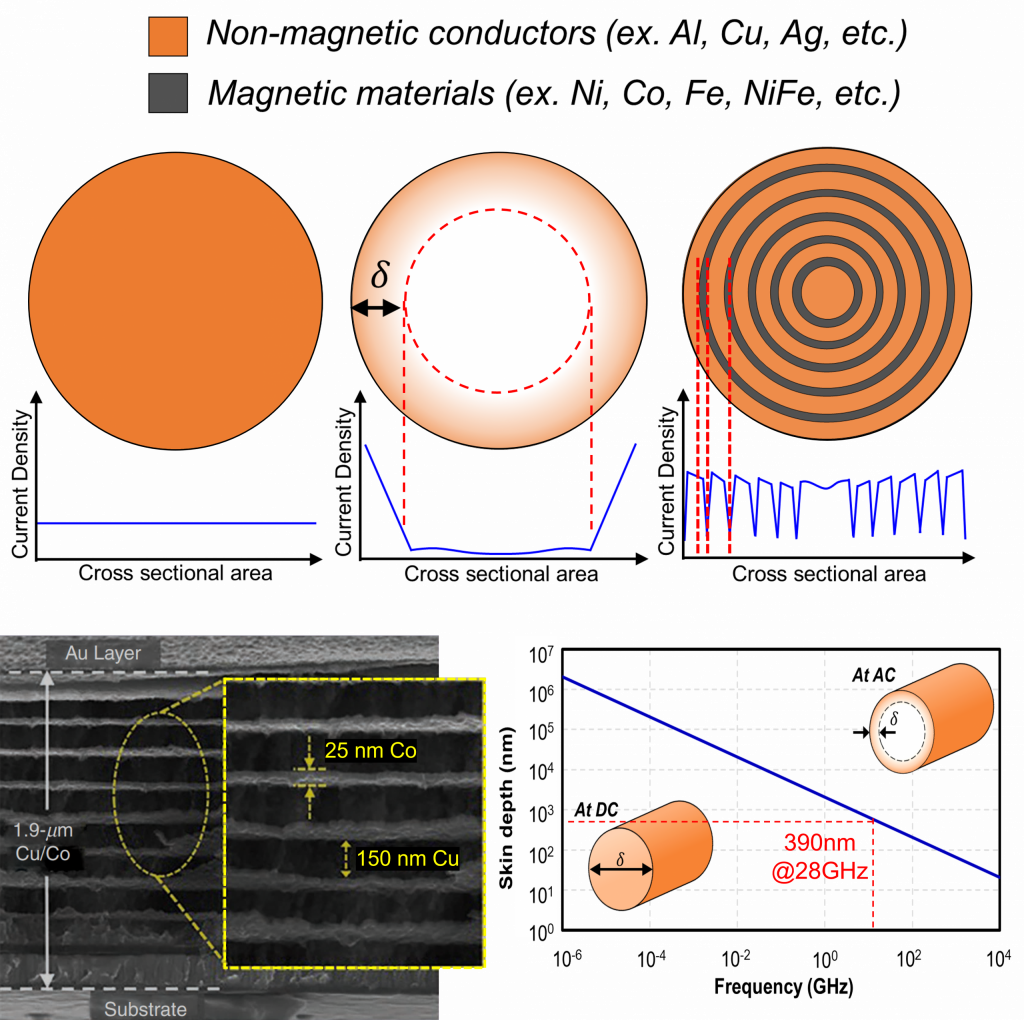
The part that we are involved in, targets developing energy efficient circuits and systems based on multi-layer metaconductors for High-Speed Wireline, RF, and mm-wave applications.
Further details can be found here.
Fig. Courtesy: R. Bowrothu, H.-i. Kim, W. Lee, T. Clingenpeel, and Y. K. Yoon, “Highly Energy-Efficient Metaconductor-Based Integrated RF Passives: Metaconductor-Based RF Passives,” IEEE Microwave Magazine, vol. 23, no. 8, pp. 83–93, 2022.
Collaborators: Prof. Yonk-Kyu Yoon (Lead PI) – University of Florida
Publications: MWSCAS 2025
Graduate Students working on the Project:
Internet of the Brain and the Nervous System
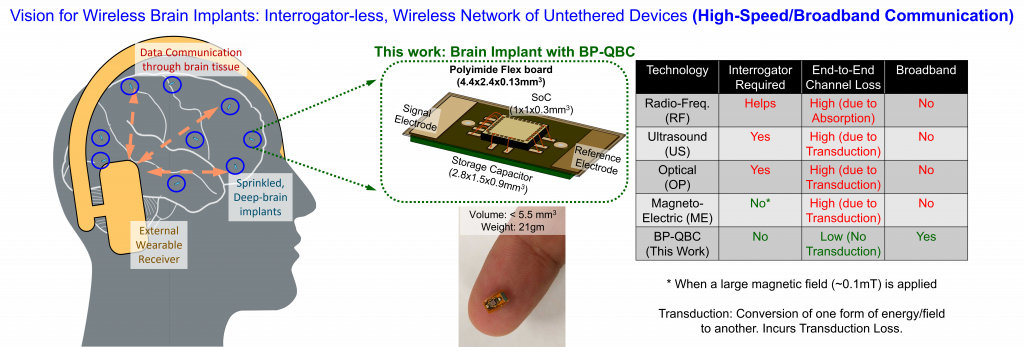
This work focuses on modeling, simulation, design, and measurements of neural implants for high-speed data transfer. The fundamental challenges being explored include energy harvesting, device injection, device migration, as well as chronic evaluation.
Collaborators: Prof. Shreyas Sen – Purdue University, Prof. Adam Khalifa – University of Florida, Prof. Shriya Srinivasan – Harvard University, Prof. Jack Judy – University of Florida
Publications: Nature Electronics 2023; BioCAS 2024; NER 2025;
Graduate Students working on the Project:
Motor Function Analysis and Prediction from EEG and ECoG Signals
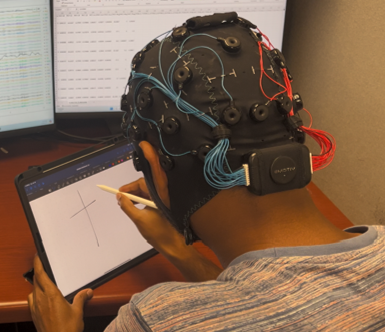
This work focuses on the analysis and prediction of motor functions from neural signals.
We are working on creating portable inferencing modules for Motor Function Prediction from EEG/ECoG.
Collaborators: Prof. Adam Khalifa – University of Florida
Publications: Scientific Reports 2025 (Nature); Sensors 2023; EMBC 2025; MWSCAS 2025
Graduate Students working on the Project: