
Our Mission: Convert Smart Systems to WISE ones
Wireless Intelligent Sensor Electronics Lab
Targeted toward Wearable and Implantable Systems Engineering
Highlighted Works

— Aug 2023: Our paper on Bi-Phasic Quasistatic Brain Communication for Energy-Efficient Wireless Neural Implants is now published in Nature Electronics (2023 Impact Factor: 33.255). This paper demonstrates how the conductive properties of the brain tissue can be utilized for creating a low-loss, electro-quasistatic mode of communication from a wireless brain implant to an external aggregator, and enable broadband/wideband data transfer in a deep brain implant due to the low end-to-end channel loss. The work was done when I was still a Ph.D. student at Purdue University. A preliminary arXived version can be found in this link for wider access.
Worldwide Press: This work on high-speed brain implants is covered in 13 News outlets, including (1) a News Article in Front Matter (National Academy of Sciences), which publishes science journalism content for the Proceedings of the National Academy of Sciences (PNAS) (The PNAS news article can be read here), (2) a News Article in TechXplore, which is a part of the Phys.org Network, covering the latest in engineering, electronics, and tech (The TechXplore news article can be found here), as well as (3) The New York Post.
Quote (excerpt from the Front Matter news article in PNAS): “It’s very attractive to have a device communicate from outside the skull to an implant,” says Jan Rabaey, a professor in electrical engineering and computer sciences, now emeritus at the University of California, Berkeley. Rabaey lauds the work, calling it “an interesting new twist on a problem a lot of people have been tackling.”
Abstract: Wearable devices typically use electromagnetic fields for wireless information exchange. For implanted devices, electromagnetic signals suffer from a high amount of absorption in tissue, and alternative modes of transmission (ultrasound, optical and magneto-electric) cause large transduction losses due to energy conversion. To mitigate this challenge, we report biphasic quasistatic brain communication for wireless neural implants. The approach is based on electro-quasistatic signalling that avoids transduction losses and leads to an end-to-end channel loss of only around 60 dB at a distance of 55 mm. It utilizes dipole-coupling-based signal transfer through the brain tissue via differential excitation in the transmitter (implant) and differential signal pickup at the receiver (external hub). It also employs a series capacitor before the signal electrode to block d.c. current flow through the tissue and maintain ion balance. Since the electrical signal transfer through the brain is electro-quasistatic up to the several tens of megahertz, it provides a scalable (up to 10 Mbps), low-loss and energy-efficient uplink from the implant to an external wearable. The transmit power consumption is only 0.52 μW at 1 Mbps (with 1% duty cycling)—within the range of possible energy harvesting in the downlink from a wearable hub to an implant.

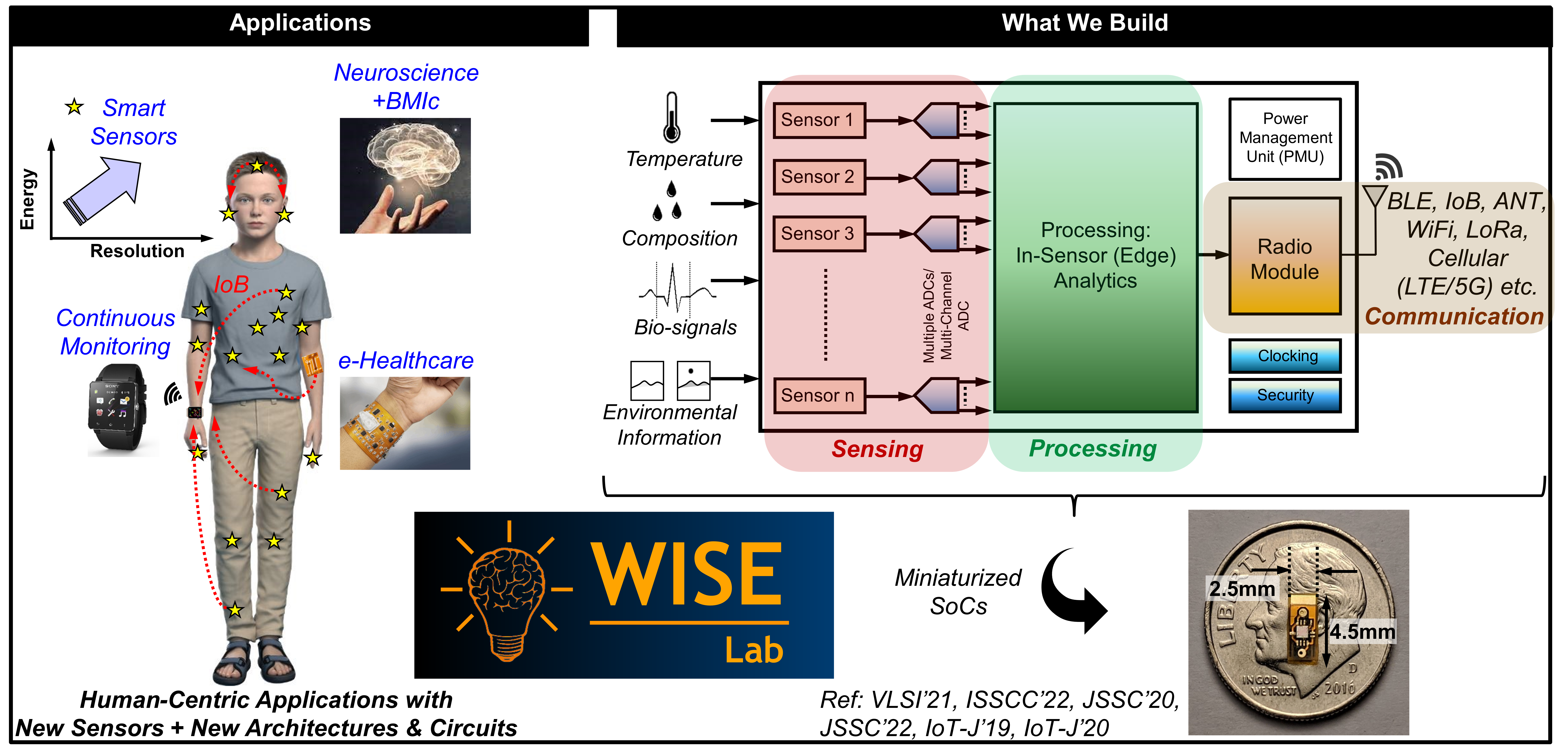
— March 2023: The future vision for IoB is Explained in this Annual Review of Biomedical Engineering (2023 Impact Factor: 11.324) Article, where the challenges and opportunities in this research area are articulated, in terms of sensing, processing, communication, powering and security of IoB nodes. The specific use-cases of Human-Body Communication (HBC) are also explained for IoB, as a differentiating factor from Wireless Body-Area Network (WBAN).
Abstract: Energy-efficient sensing with physically secure communication for biosensors on, around, and within the human body is a major area of research for the development of low-cost health care devices, enabling continuous monitoring and/or secure perpetual operation. When used as a network of nodes, these devices form the Internet of Bodies, which poses challenges including stringent resource constraints, simultaneous sensing and communication, and security vulnerabilities. Another major challenge is to find an efficient on-body energy-harvesting method to support the sensing, communication, and security submodules. Due to limitations in the amount of energy harvested, we require a reduction in energy consumed per unit information, making the use of in-sensor analytics and processing imperative. In this article, we review the challenges and opportunities of low-power sensing, processing, and communication with possible powering modalities for future biosensor nodes. Specifically, we analyze, compare, and contrast (a) different sensing mechanisms such as voltage/current domain versus time domain, (b) low-power, secure communication modalities including wireless techniques and human body communication, and (c) different powering techniques for wearable devices and implants.
Specific Research Directions:
1) Internet of Bodies (IoB): Seamless and Secure connectivity on, in, and around the human body
2) Low-Power and Highly Stable On-Chip Clocking Solutions
3) Intelligent Sensing Mechanisms: Context-aware, Low-power/Energy-efficient
4) Miniaturized, Secure IoT Nodes: General purpose nodes and hardware (COTS/ASIC) design
5) Continuous Monitoring and e-Healthcare: Application-driven ASIC design
6) Neural Interfaces and Neuromorphic Systems
Research Highlight:
Areas: Analog/Digital/Mixed-SIgnal/RF VLSI Circuit Design, System Design, IoT, ML
WISE Lab Research and Education Sponsors:








Current Openings:
Please contact me by email at chatterjee.b@ufl.edu with your CV.