
University of Florida | Herbert Wertheim College of Engineering
Overview
In the coming years, artificial intelligence (AI) will quickly transition from acting as intelligent chatbots to controlling a wide variety of robots, autonomous vehicles, and other physical systems. The ability to interact in the physical world brings an increased level of danger caused by unanticipated behaviors, failures in the networks that these systems rely on for communication and coordination, or even deliberate malicious attacks.
This REU site will engage eight undergraduate college students in scientific research on assured autonomy and networking. Students will gain hands-on experience with autonomous vehicles, robots, networks, and sensors at the unique University of Florida Autonomy Park. Our goal is to equip students with the knowledge, experience, and motivation to pursue challenging research problems in ensuring safe and reliable operation of AI-controlled systems.
Program Details
- Duration: 10-weeks
- Dates: May 23, 2026 – August 1, 2026
- Location: University of Florida, Gainesville, FL
- Participants: 8 undergraduate students
- Stipend: $7000 stipend plus housing, meals, and travel support
- Application Deadline: February 21, 2026
Research Focus
Our research focuses on assured autonomy and networking – providing reliable and predictable operation of autonomous systems operating in unpredictable environments with networked communication over unreliable channels. We are particularly interested in challenging scenarios where adversarial agents attempt to disrupt operations.
Research Thrusts
Students will engage in cutting-edge research across the 11 major thrusts show below. Click on any of the thrusts to go to see a more detailed description. Or visit the full Research Thrusts page.
- Deep Learning for Autonomous Networks – Real-time learning for air and ground agents
- Robust 5G Communication – Securing cellular communications for autonomous systems
- Game-theoretic Cyber-Physical Defense – Symbiotic systems that defend against attacks
- Human-Swarm Interactions with XAI – Explainable AI for drone swarm operations
- Autonomous Rendezvous and Docking – Reinforcement learning for space systems
- Distributed Timing & Localization – GPS-denied environment navigation
- Attack Surface Analysis – Cybersecurity for autonomous vehicle software
- Real-time Spacecraft Control – Assured decision making for satellites
- Evolutionary Neural Architecture Search – Optimized AI for resource-constrained systems
- Multi-Agent Safety with Irrational Actors – Game theory with imperfect rationality
- Physically Grounded World Modeling – Generative AI for physical systems
Unique Resources
UF Autonomy Park
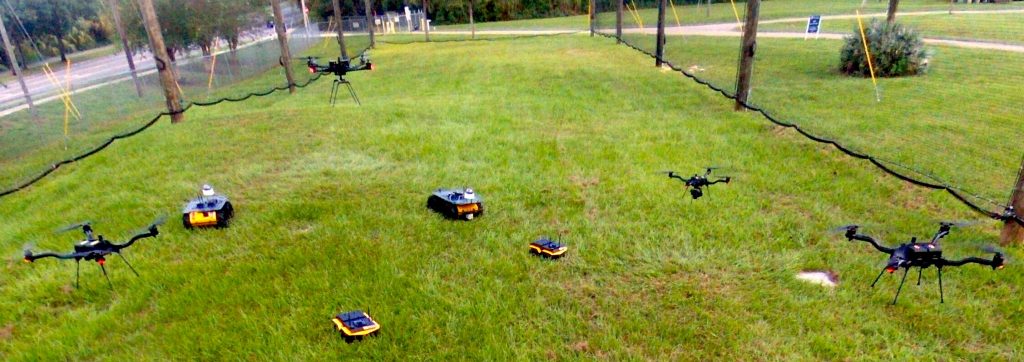
Students will conduct experiments using the UF Autonomy Park – a large netted outdoor facility equipped with:
- Unmanned aerial vehicles (drones)
- Wheeled and walking robots
- Software-defined radios for wireless connectivity
- Realistic sensing and communication capabilities
- Safe environment for collaborative and adversarial experiments
Professional Development
Student Training
- Week 1-2: Intensive orientation covering research fundamentals, safety, and ethics
- Weeks 3-9: Weekly seminars on technical topics and professional development
- Week 10: REU Site Symposium with student presentations
Industry Connections
- Networking events with companies like L3Harris, Northrop-Grumman, and Lockheed-Martin
- Travel stipend to attend IEEE or ACM conferences
- Professional development workshops including GRE preparation
Social & Cultural Activities
Take advantage of different aspects of life in Florida, including
- Beach trips to Melbourne, FL
- Visits to Kennedy Space Center
- Tubing down the Ichetucknee River
- UF Gator Nights entertainment events
- Lake Wauburg recreation activities
Leadership Team and Faculty Mentors
Principal Investigator: Dr. John M. Shea, Professor, Electrical & Computer Engineering
Co-Principal Investigator: Dr. Norman Fitz-Coy, Associate Professor, Mechanical & Aerospace Engineering
Our diverse team of 12 faculty mentors spans four departments:
- Electrical & Computer Engineering (ECE)
- Mechanical & Aerospace Engineering (MAE)
- Computer & Information Science & Engineering (CISE)
- Civil & Coastal Engineering (CCE)
Who Should Apply
We seek sophomore and junior engineering and computer science students who are:
- Interested in autonomous systems, networking, and cybersecurity
- Motivated to conduct hands-on research
- Committed to a 10-week summer experience
- Ready to work collaboratively in interdisciplinary teams
We encourage applications from:
- Female and underrepresented minority students
- Students from non-research colleges and universities
- Students from historically black colleges and universities (HBCUs)
- Students from two-year colleges
How to Apply
Application Process:
- Submit application through NSF’s ETAP system
- Provide academic transcripts
- Submit two letters of recommendation
- Write a statement of purpose describing your interest in specific research areas
Application Timeline:
- Late December 2025: Applications open
- February 21, 2026: Application deadline
- February 22–28, 2026: Student selection and notification
- April 2: Final deadline to accept offers
Contact Information
Email: jshea@ece.ufl.edu
Funding Acknowledgment
This REU Site is supported by the National Science Foundation. The University of Florida is an Equal Opportunity Institution.
Last updated: 1/1/2026