
Media
2D Magnetic Materials & Devices
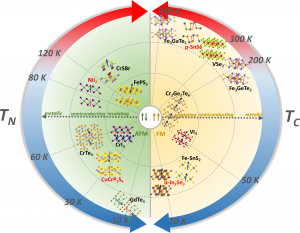
By harnessing the quantum effects that emerge in low dimensions, researchers can create novel magnetic systems with remarkable controllability and efficiency. These materials have the potential to revolutionize a wide range of applications, including data storage, spintronics, and quantum computing. Their reduced size and energy consumption make them particularly appealing for future electronic devices, offering the potential to enhance information processing speed and energy efficiency, while also enabling the development of smaller, more compact technologies that can reshape the landscape of modern electronics. As research in low-dimensional magnetic materials and devices continues to advance, we are on the cusp of unlocking groundbreaking possibilities for the future of technology.
These 2D magnets exhibit metallic, semiconducting, and insulating properties, along with magnetic characteristics ranging from ferromagnetism and antiferromagnetism to multiferroics. Our interests focus on topological magnetic materials, room-temperature magnets, and multiferroic interface. Please refer to Publications Section, paper [1-12] for more details.
Nonvolatile control using Ferroelectrics
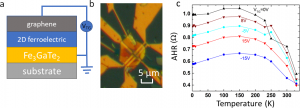
Nonvolatile control through ferroelectric materials is a transformative approach in modern electronics. These materials possess a unique property called ferroelectricity, which allows them to maintain a stable polarization state even in the absence of an external electric field, making them ideal candidates for nonvolatile memory and data storage applications. By utilizing the inherent switchability of the ferroelectric domains, it is possible to store and retrieve data with extremely low power consumption and high-speed performance. Beyond memory applications, ferroelectric materials are also employed in nonvolatile control elements for various electronic devices, such as spin field-effect transistors and memristors, enabling energy-efficient and durable circuit design. This innovative approach to nonvolatile control not only addresses the ever-increasing demand for low-power and high-performance electronics but also paves the way for the development of advanced, nonvolatile data storage and processing technologies.
We fabricate and assemble high-quality multiferroic interface for nonvolatile devices, using 2D ferroelectric layers like Cu2In2P2S6 (CIPS) and In2Se3. 2D ferromagnet are in few-layers, to achieve 100% magnetization switching. Please refer to Publications Section, paper [15,22,24] for more details.
Topological Spintronics
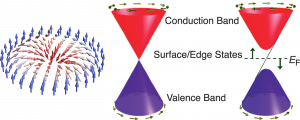
Topological spintronics is a rapidly evolving field at the intersection of condensed matter physics and spintronics, which exploits the unique properties of topological materials to create revolutionary electronic devices. In topological spintronics, the focus is on harnessing the robust and protected nature of topological states in these materials to manipulate and transport electron spins with unprecedented precision and efficiency. Topological protection enables robustness against perturbations and fault-tolerance, important factors to be considered in the development of unconventional computing like quantum computing.
Our approach includes:
(1) Real space topology like magnetic skyrmions, utilizing the transition from classical to quantum domain.
(2) momentum space topology like quantum Hall effect, utilizing quantized resistance.
Please refer to Publications Section, paper [11,13-20] for more details.
Superconductivity
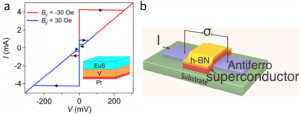
Low-dimensional superconductivity, with a specific focus on superconducting diodes and interface control. When superconductivity is confined to nanoscale or two-dimensional structures, novel and tunable phenomena emerge. Superconducting diodes, formed by carefully designed junctions, leverage these low-dimensional properties to enable efficient and ultra-sensitive detectors of electromagnetic radiation. The interface control of superconductivity, on the other hand, involves engineering the boundary regions between superconducting materials and other compounds, which can be used to manipulate the properties of superconductors, such as critical temperatures and energy gaps. By tailoring these interfaces, researchers aim to develop next-generation electronic devices, including energy-efficient transistors and quantum bits for quantum computing, unlocking the potential for revolutionary advances in technology and fundamental physics. This multifaceted research area holds great promise for reshaping the landscape of both classical and quantum electronics. Please refer to Publications Section, paper [10,12,15,22] for more details.
Machine learning combined materials and devices research
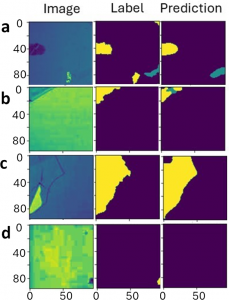
Machine learning is revolutionizing materials and devices research in the field of spintronics by enabling the rapid discovery and optimization of novel materials with desirable spintronic properties. By leveraging large datasets and advanced algorithms, machine learning models can predict the behavior of materials at the atomic level, identify patterns, and suggest new material combinations that may exhibit enhanced performance. This approach accelerates the design of spintronic devices, which exploit the intrinsic spin of electrons for data storage and processing, leading to faster, more efficient, and scalable technologies. Integrating machine learning with experimental research allows for the iterative refinement of materials, reducing the time and cost traditionally associated with the trial-and-error methods, and paving the way for breakthroughs in quantum computing, memory devices, and beyond. Our focus in on:
(1) identifying materials thickness;
(2) creating new topological magnetic orders;
(3) processing spin textures and predicting new magnetic orders.
Please refer to Publications Section, paper [17,25] for more details.
Neuromorphic computing
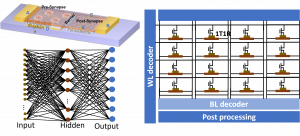
Skyrmions in neuromorphic computing offer a compelling and transformative approach to mimic the intricate functioning of the human brain within artificial neural networks. Skyrmions are topological spin textures with a robust stability that can represent binary information or synapse-like connections, making them ideal candidates for non-volatile memory elements. Their small size, energy efficiency, and the ability to manipulate them with low power requirements, make them an attractive choice for emulating the dynamic interconnections of biological neurons. By encoding and processing information through the movement and interaction of skyrmions, neuromorphic systems can achieve high-density, low-power, and high-speed computing, effectively bridging the gap between conventional computing and brain-inspired cognitive processes. Research in this field holds the promise of revolutionizing artificial intelligence and cognitive computing by enabling more efficient and biologically inspired information processing. Please refer to Publications Section, paper [16,20,22-24] for more details.
Quantum Computing
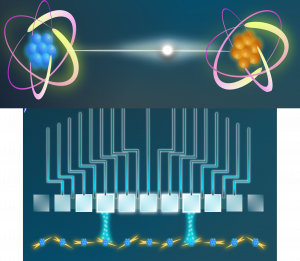
We aim to combine topology into quantum computing and quantum memory by providing quantum devices with scalability, energy efficiency and ultra-fast speeds. The approach not only holds the promise of creating highly coherent and fault-tolerant quantum processors but also opens the door to addressing some of the key challenges in quantum computing, such as qubit coherence and connectivity. By exploiting the synergistic relationship between these materials, quantum computers can tackle complex problems with previously unimaginable efficiency, propelling us closer to the realization of quantum supremacy and revolutionary advances in computational capabilities. Please refer to Publications Section, paper [15,22,23] for more details.
References:
[1] B. Zhang, P. Lu, R. Tabrizian, P. X.-L. Feng, Y. Wu; 2D Magnetic Heterostructures: Spintronics and Quantum Future, npj Spintronics 2, 6, 2024;
[2] Y. Wu, Z. Sofer, W. Wang; Room-temperature Ferroelectric Control of 2D Layered Magnetism, arXiv:2406.16211, 2024;
[3] K. L. Wang, Y. Wu, C. Eckberg, G. Yin, and Q. Pan. Topological Quantum Materials, MRS Bulletin, 45(5), 373-379, 2020;
[4] Y. Hou, F. Nichele, H. Chi, A. Lodesani, Y. Wu, M. F. Ritter, D. Z. Haxell, M. Davy-dova, S. Ilic, O. Glezakou-Elbert, A. Varamally, F. Sebastian Bergeret, A. Kamra, L. Fu, P. A. Lee, J. S. Moodera; Ubiquitous Superconducting Diode Effect in Superconductor Thin Films, Physical Review Letters 131, 027001, 2023.
[5] P. A. Leger, A. Ramesh, T. Ulloa, Y. Wu; Machine-Learning-Enabled Fast Optical Identification and Characterization of 2D Materials, arXiv:2406.13859, 2024,
Date sharing and management
- Machine learning for materials characterization published in Scientific Reports 2024 (Publication 25):
The datasets generated during and/or analyzed during the current study are available in the GitHub repository
- Simulation for neuromorphic computing hardware, 2025 (Publication 30) :
The datasets generated during and/or analyzed during the current study are available in the GitHub repository.
- Quantum simulation for superconducting quantum diodes, 2025 (Publication 31):
The datasets generated during and/or analyzed during the current study are available in the GitHub repository.
- Micromagnetic simulation for skyrmion quantum diodes, 2026 (Publication 32):
The datasets generated during and/or analyzed are available in the GitHub repository.