
Overview
Silicon carbide (SiC) has emerged as a transformative material platform at the intersection of nanophotonics, nanomechanics, quantum information science, and precision sensing. We are engineering microscopic, highly resilient resonating structures out of SiC to serve as the foundational building blocks for next-generation technologies. Today, standard micro-devices rely on traditional materials like silicon and electrical readouts, which inevitably degrade under extreme conditions and introduce too much interference for delicate quantum operations. Our approach breaks past these limits by combining the extreme physical toughness of SiC with the precision of cavity optomechanics—using trapped laser light to read incredibly faint, atomic-level vibrations. SiC excels in harsh environments, while light-based measurement completely eliminates electrical noise. This combination enables our novel resonators to achieve unprecedented stability and sensitivity. The technology extends far beyond measurement capabilities, opening new pathways for robust quantum photonic networks, ultra-sensitive detection systems, and coherent signal transduction that will define the future of advanced communications.
Featured Publications:

Ultracompact 4H-Silicon Carbide Optomechanical Resonator with fm· Qm Exceeding 1013 Hz
We demonstrated the first integrated 4H-SiC optomechanical resonator on a low-loss SiC-on-insulator platform, achieving an unprecedented fm·Qm product of 1.82×10¹³ Hz at room temperature in ambient conditions. This work establishes 4H-SiCOI as a premier platform for chip-scale quantum optomechanics, precision metrology, and operation in extreme environments where conventional materials fail
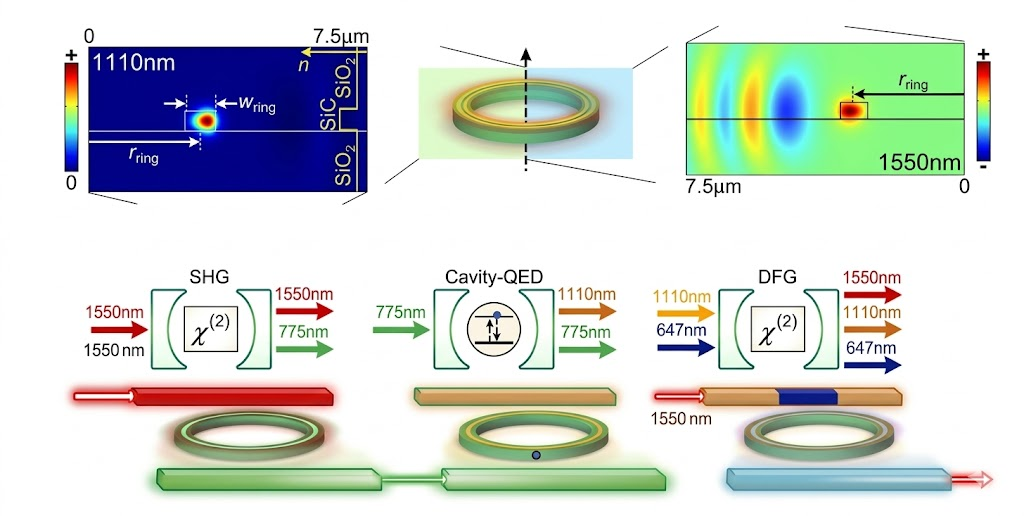
Single-crystal 3C-SiC-on-insulator platform for integrated quantum photonics
This theoretical work systematically engineered a 3C-SiCOI platform for multi-functional quantum photonic circuits, addressing cavity-QED, nonlinear frequency conversion, and wafer-scale manufacturability. It provides concrete guidelines for realizing SiCOI integrated circuits interfacing quantum emitters with telecommunication networks.

High Q silicon carbide microdisk resonator
We demonstrated 3C-SiC microdisk resonators with intrinsic optical Q up to 5.12×10⁴—the highest reported for SiC at the time—through optimized fabrication. This work establishs 3C-SiC microdisks as promising for integrated quantum photonics

Silicon carbide microdisk resonator
Our first demonstration of a 3C-SiC microdisk optical resonator, establishing the feasibility of the platform. Though early-stage, this work demonstrated SiC’s advantages—high thermal conductivity, wide bandgap, and large refractive index—motivating subsequent platform development.

We created the first SiC/h-BN hybrid optomechanical device, demonstrating strong mechanical coupling between a 3C-SiC microdisk cavity and a van der Waals hexagonal boron nitride nanomechanical resonator. This hybrid approach combines SiC’s wide bandgap with h-BN’s room-temperature single photon emission, opening pathways for cavity quantum electrodynamics and coherent quantum transduction.

Spatial mapping of multimode Brownian motions in high-frequency silicon carbide microdisk resonators
Using ultra-sensitive scanning laser interferometry, we directly measured and spatially mapped undriven thermomechanical (Brownian) vibrations up to the ninth flexural mode in SiC microdisks—achieving displacement sensitivities of 7-14 fm/√Hz. The multimode mapping capability enables new modalities for sensing and reveals rich physics of high-order Brownian motions, with implications for quantum-limited measurements

6H-SiC microdisk torsional resonators in a “smart-cut” technology
We demonstrated high-frequency torsional resonators in 6H-SiC using a “smart-cut” ion-slicing process, achieving mechanical frequencies up to 60 MHz with quality factors reaching 1,280. This work expanded the SiC resonator toolkit beyond flexural modes, with applications in precision sensing and potential for coupling to mechanical degrees of freedom in hybrid quantum systems.

Polytype control of spin qubits in silicon carbide
This collaborative work demonstrated that 4H, 6H, and 3C polytypes of SiC all host coherent, optically addressable defect spin states with room-temperature quantum coherence. It established SiC as a versatile platform where crystal polymorphism enables “designer” spin qubits, directly motivating our subsequent integration of quantum emitters with photonic cavities
References:
- Liu Y, Sun W, Abiri H, Feng PXL*, Li Q, “Ultracompact 4H-Silicon Carbide Optomechanical Resonator with fmQm Exceeding 10¹³ Hz”, Photonics Research 13, 2531-2538 (2025). DOI: https://doi.org/10.1364/PRJ.567674.
- Liu Y, Wang Y, Zheng XQ, Lin Q, Feng PXL, “Nanomechanical and Optomechanical Coupling in Silicon Carbide / Hexagonal Boron Nitride Hybrid Resonator”, Tech. Digest of the 21st Int. Conf. on Solid-State Sensors, Actuators and Microsystems (Transducers 2021 Virtual Conference), 541-544, Online, June 20-24 (2021). DOI: https://doi.org/10.1109/Transducers50396.2021.9495564