


For up-to-date publication information, please visit Prof. Kim’s Google Scholar or ORCID pages.
Select Publications


Modeling Temperature-Dependent Electron Thermal Diffuse Scattering via Machine-Learned Interatomic Potentials and Path-Integral Molecular Dynamics
Phys. Rev. Lett. 132, 086301 (2024)
Three-dimensional atomic packing in amorphous solids with liquid-like structure
Nat. Mater. 21, 95 (2022)
Correlating the three-dimensional atomic defects and electronic properties of two-dimensional transition metal dichalcogenides
Nat. Mater. 19, 867 (2020)
Capturing 3D atomic defects and phonon localization at the 2D heterostructure interface
Sci. Adv., 7, 38, eabi6699 (2021)
Observing crystal nucleation in four dimensions using atomic electron tomography
Nature, 570, 7762, 500 (2019)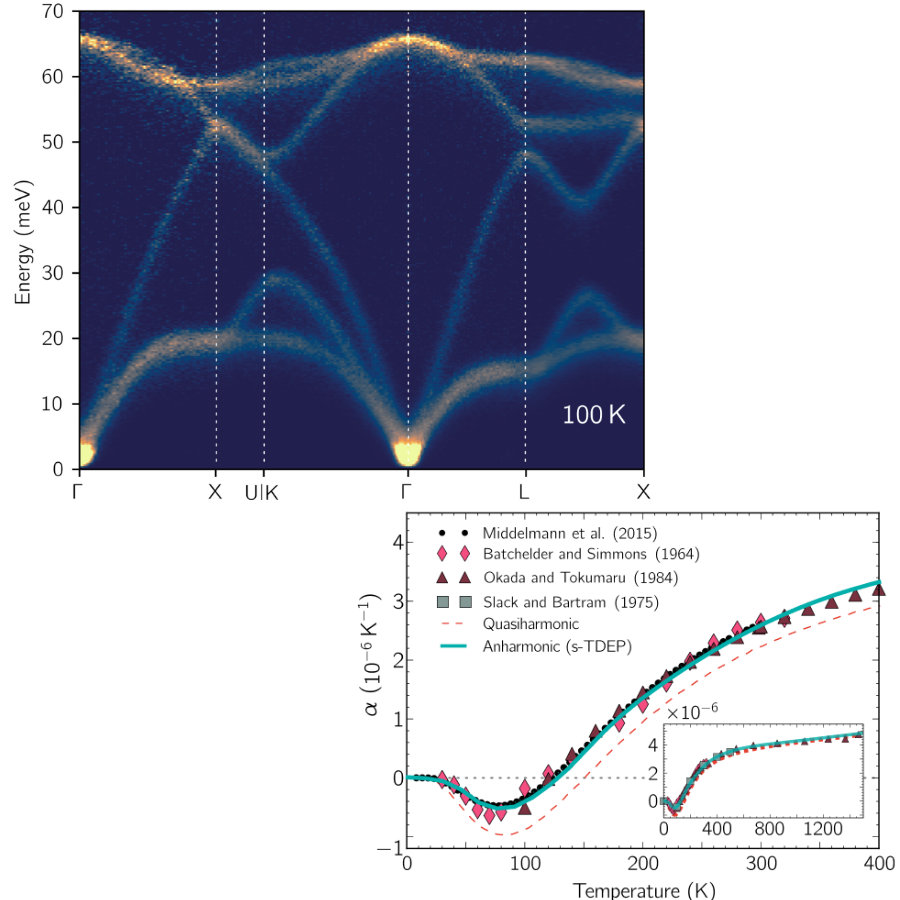
Nuclear quantum effect with pure anharmonicity and the anomalous thermal expansion of silicon
Proc. Natl. Acad. Sci. USA 115, 1992 (2018)All publications
† denote equal contribution, ‡ denote corresponding authorship, bold names denote PERL Team member
25. Y. Yuan, S. Moniri, Y. Yang, J. Zhou, A. Yuan, D.S. Kim, Y. Yang, C. Li, W. Chen, P. Ercius,
J. Miao, “Crystal nucleation and growth in high-entropy alloys revealed by atomic electron
tomography”, arXiv:2504.11325 (2025).
24. N.Y. Kim, H. Zhong, J. Zhang, C. O’Leary, Y. Liao, J. Zou, H. Sha, M. Pham, W. Li, Y. Yuan, J.H.
Park, D.S. Kim, H. Jiang, J. Kong, M. Chi, J. Miao, “Determining 3D atomic coordinates of light-element quantum materials using ptychographic electron tomography”, arXiv:2504.08228 (2025).
23. C.N. Saunders, V.V. Ladygin, D.S. Kim, D.L. Abernathy, B.T. Fultz, “Diffuse inelastic neutron
scattering from anharmonic vibrations in cuprite”, Phys. Rev. Mater. 9, 024602 (2025).
22. D.S. Kim, C. Harris, M.D. Hanwell, B. Zhou, D. Chang, C. Ophus, P. Ercius, and J. Miao, “Ma-
terials Data Bank, a modern open-source database for experimental atomic structure dissemination”, under review at Sci. Data (2025).
21. D.S. Kim‡, M. Xu, and J.M. LeBeau‡, “Modeling Temperature-Dependent Electron Thermal
Diffuse Scattering via Machine-Learned Interatomic Potentials and Path-Integral Molecular
Dynamics”, Phys. Rev. Lett. 132 (8), 086301 (2024).
20. F. Knoop, N. Shulumba, A. Castellano, J.P. Alvarinhas Batista, R. Farris, M.J. Verstraete, M.
Heine, D. Broido, D.S. Kim, J. Klarbring, I. Abrikosov, S.I. Simak, O. Hellman, “TDEP: Tem-
perature Dependent Effective Potentials”, J. Open Source Softw., 9(94), 6150 (2024).
19. C.M. Bernal-Choban, H.L. Smith, C. Saunders, D.S. Kim, D.L. Abernathy, and B. Fultz, “Non-
harmonic contributions to the high-temperature phonon thermodynamics of Cr”, Phys. Rev. B, 107, 054312 (2023).
18. H.G. Seo, A. Staerz, D.S. Kim, J.M. LeBeau, H.L. Tuller. “Tuning surface acidity of mixed
conducting electrodes: Recovery of Si-induced degradation of oxygen exchange rate and
area specific resistance”, Adv. Mater., 35, 2208182 (2023).
17. X. Chen†, D.S. Kim†, and J.M. LeBeau, “A Comparison of Molecular Dynamics Potentials
Used to Incorporate Thermal Diffuse Scattering in Multislice Simulations”, Ultramicroscopy,240, 113644 (2023).
16. H.G. Seo, A. Staerz, D.S. Kim, D. Klotz, C. Nicollet, M. Xu, J.M. LeBeau, H.L. Tuller. “Reacti-
vation of chromia poisoned oxygen exchange kinetics in mixed conducting solid oxide fuel
cell electrodes by serial infiltration of lithia”, Energy Environ. Sci. 15, 4038-4047 (2022).
MIT News: “A simple way to significantly increase lifetimes of fuel cells and other devices”
news.mit.edu (2022).
15. C. Saunders, D.S. Kim, O. Hellman, H.L. Smith, N.J. Weadock, S.T. Omelchenko, G.E. Granroth,
C.M. Bernal, S.H. Lohaus, D.L. Abernathy, and B. Fultz, “Thermal expansion and phonon an-
harmonicity of cuprite (Cu2O)”, Phys. Rev. B 105, 174308 (2022).
14. A. Staerz, H.G. Seo, D. Klotz, D.S. Kim, J.M. LeBeau, H.L. Tuller. “The influence of Cr-
additives on the polarization resistance of praseodymium-doped ceria cathodes for solid
oxide fuel cells”, J. Electrochem. Soc 169 044530 (2022).
13. Y. Yuan†, D.S. Kim†, J. Zhou†, D.J. Chang, F. Zhu, Y. Nagaoka, Y. Yang, M. Pham, S.J. Os-
her, O. Chen, P. Ercius, A.K. Schmid, and J. Miao, “Three-dimensional atomic packing in
amorphous solids with liquid-like structure”, Nat. Mater. 21, 95–102 (2022).
12. X. Tian, X. Yan, G. Varnavides, Y. Yuan, D.S. Kim, C.J. Ciccarino, P. Anikeeva, P. Narang,
X. Pan, and J. Miao, “Capturing 3D atomic defects and phonon localization at the 2D het-
erostructure interface”, Sci. Adv. 7, 38 (2021).
11. Y. Yang, J. Zhou, F. Zhu, Y. Yuan, D.J. Chang, D.S. Kim, M. Pham, A. Rana, X. Tian, Y. Yao,
S. Osher, A.K. Schmid, L. Hu, P. Ercius, and J. Miao, “Determining the three-dimensional
atomic structure of an amorphous solid”, Nature, 592, 60–64 (2021).
News & Views in Nature 592, 31-32 (2021).
10. D.S. Kim‡, O. Hellman, N. Shulumba, C. Saunders, J.Y.Y. Lin, H.L. Smith, J. Herriman, J.L.
Niedziela, D.L. Abernathy, C.W. Li, and B. Fultz‡, “Temperature-dependent phonon lifetimes
and thermal conductivity of silicon by inelastic neutron scattering and ab initio calculation”,
Phys. Rev. B, 102, 174311 (2020).
9. D. Chang, D.S. Kim, X. Tian, J. Zhou, P. Ercius, and J. Miao, “Ptychographic Atomic Electron
Tomography: Towards 3D Imaging of Individual Light Atoms in Materials”, Phys. Rev. B.,102, 174101 (2020).
8. X. Tian†, D.S. Kim†, S. Yang†, C.J. Ciccarino, Y. Gong, Y. Yang, Y. Yang, Y. Yuan, B. Duschatko,
P.M. Ajayan, J-C. Idrobo, P. Narang, and J. Miao, “Correlating the three-dimensional atomic
defects and electronic properties of two-dimensional transition metal dichalcogenides ”,
Nat. Mater. 19, 867–873 (2020).
News & Views in Nat. Mater. 19, 827–828 (2020).
7. J. Zhou, Y.S. Yang, Y. Yang, D.S. Kim, A. Yuan, X. Tian, C. Ophus, F. Sun, A.K. Schmid, M.
Nathanson, H. Heinz, Q. An, H. Zeng, P. Ercius, and J. Miao, “Observing crystal nucleation in
four dimensions using Atomic electron tomography”, Nature, 570, 500-503 (2019).
News & View in Nature 570, 450-452 (2019)
6. D.S. Kim†‡, O. Hellman, J. Herriman, H.L. Smith, J.Y.Y. Lin, N. Shulumba, J.L. Niedziela, C.W.
Li, D.L. Abernathy, and B. Fultz‡, “Nuclear quantum effect with pure anharmonicity causes
the anomalous thermal expansion of silicon”, Proc. Natl. Acad. Sci. U.S.A. 115 (9) 1992-1997 (2018).
Editor’s Choice in “Silicon sheds its harmonicity” Science ,360, 6385 (2018).
5. H.L. Smith, Y. Shen, D.S. Kim, F.C. Yang, C.P. Adams, C.W. Li, D.L. Abernathy, M.B. Stone and
B. Fultz, “The temperature dependence of phonons in FeGe2”, Phys. Rev. Mater. 2, 103602 (2018).
4. H.L. Smith, C.W. Li, A. Hoff, G.R. Garrett, D.S. Kim, F.C. Yang, M.S. Lucas, T. Swan-Wood, J.Y.Y.
Lin, M.B. Stone, D.L. Abernathy, M. Demetriou, and B. Fultz, “Separating the configurational
and vibrational entropy contributions in metallic glasses”, Nat. Phys. 13, 900-905 (2017).
3. T. Lan, C.W. Li, O. Hellman, D.S. Kim, J.A. Muñoz, H.L Smith, D.L. Abernathy, and B. Fultz,
“Phonon quarticity induced by changes in phonon-tracked hybridization during lattice ex-
pansion and its stabilization of rutile TiO2”, Phys. Rev. B 92, 054304 (2015).
2. D.S. Kim‡, H.L Smith, J.L. Niedziela, C.W. Li, D.L. Abernathy, and B. Fultz‡, “Phonon Anhar-
monicity in Silicon from 100 to 1500 K”, Phys. Rev. B 91, 014307 (2015).
1. T. Lan, C.W. Li, O. Hellman, D.S. Kim, J.A. Muñoz, H.L Smith, D.L. Abernathy, and B. Fultz,
“Phonon quarticity induced by changes in phonon-tracked hybridization during lattice ex-
pansion and its stabilization of rutile TiO2”, Phys. Rev. B 92, 054304 (2015).