
“There is no scientific study more vital to man than the study of his own brain. Our entire view of the universe depends on it.”
Francis crik
Basic Neuroscience
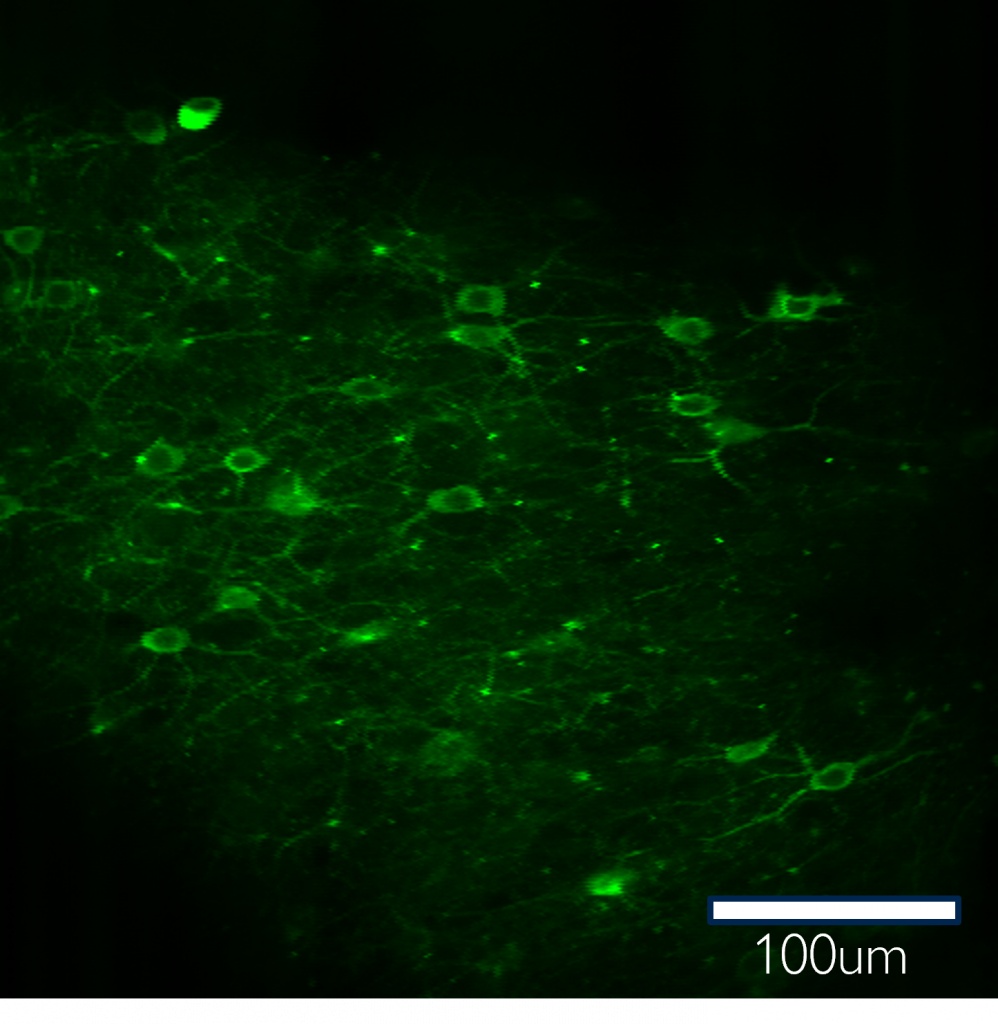
My lab has a long-standing interest in investigating the neural mechanisms underlying sensorimotor integration, and the extent to which they can guide the engineering of clinically viable Brain machine Interfaces (BMIs). In particular, we seek to characterize the interaction between cortical and subcortical structures at the cellular and population levels during goal-directed behavior. Some sample publications:
- I-Wen Chen, Chung Yuen Chan, Phillip Navarro. Vincent de Sars, Emiliano Ronzitti, Karim Oweiss, Dimitrii Tanese, Valentina Emiliani (2025) “High-throughput synaptic connectivity mapping using in vivo two-photon holographic optogenetics and compressive sensing” Nature Neuroscience, doi: 10.1038/s41593-025-02024-y
- S. Eldawlatly, K. Oweiss, (2014) “Temporal precision in population – but not individual neuron – dynamics reveals rapid experience-dependent plasticity in the rat barrel cortex” Frontiers in Computational Neuroscience, Vol 8, doi: 10.3389/fncom.2014.00155
- S. Eldawlatly, K. Oweiss (2011) “Millisecond-Timescale Local Network Coding in the Rat Primary Somatosensory Cortex,” PLoS ONE 6(6): e21649. PMID: 21738751
- M. Aghagolzadeh, S. Eldawlatly and K. Oweiss, (2010) “Synergistic Coding by Cortical Neural Ensembles” IEEE Transactions on Information Theory, 56:2, 875-899, PMID: 20376281
- K. Oweiss, I. Badreldin (2015) “Neuroplasticity subserving the operation of Brain Machine Interfaces,” Journal of Neurobiology of Disease
Machine Learning and AI
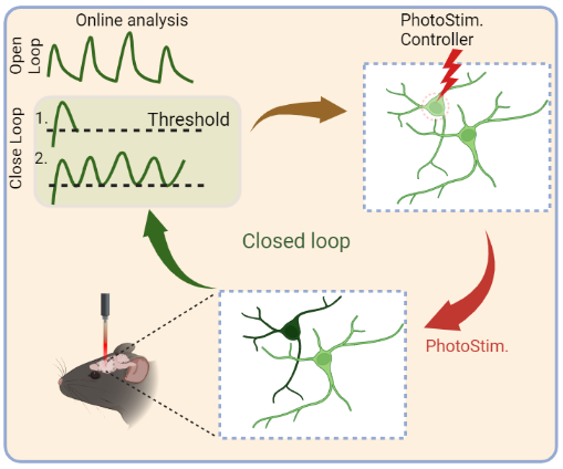
We design and apply neural signal processing and feedback control algorithms for bi-directional neural interface systems, while embedding them into application-specific integrated circuits optimized for size, power consumption, and wireless operation for full implantation in the body. Our work also extends to developing agentic AI models inspired by principles of neuroplasticity and biological intelligence, bridging neuroscience with artificial intelligence to advance both clinical translation and machine learning theory. Some sample publications:
- K. Oweiss, Editor (2010), Statistical Signal Processing for Neuroscience and Neurotechnology, Academic Press, Elsevier, 1st edition, ISBN-13: 978-0-12-375027-3.
- S. Eldawlatly, Y. Zhou, R. Jin and K. Oweiss, (2010) “On The Use of Dynamic Bayesian Networks in Reconstructing Functional Neuronal Networks from Spike Train Ensembles”, Journal of Neural Computation, MIT Press, 22:1, pp. 158-189, PMID: 19852619
- F. Zhang, M. Aghagolzadeh, and K. Oweiss, (2012) “A Fully Implantable, Programmable and Multimodal Neuroprocessor for Wireless, Cortically Controlled Brain-Machine Interface Applications,” Journal of Signal Processing Systems, pp. 1-11, doi:10.1007/s11265-012-0670
- K. Oweiss, A. Mason, Y. Suhail, A. Kamboh, K. Thomson (2007) “A Scalable Wavelet Transform VLSI Architecture for Real-Time Signal Processing in High Density Intra-cortical Implants,” IEEE Transactions on Circuits and Systems, 54:6, pp. 1266-1278
Translational Neuroscience
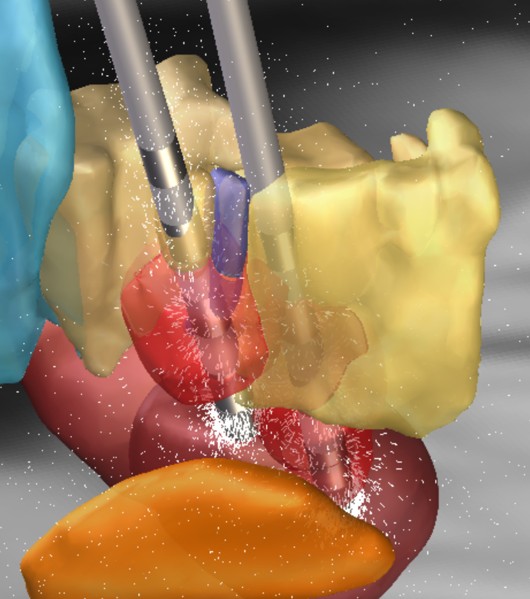
We develop computational models of basal ganglia circuits to elucidate mechanisms of Deep Brain Stimulation (DBS) and optimize its parameters for conditions such as Parkinson’s disease, essential tremor, and sensory restoration. Our goal is to provide a systems-level understanding of DBS and develop feedback control techniques for closed-loop stimulation that minimize adverse effects of current open-loop approaches. Some sample publications:
- J. Liu, H. Khalil, K. Oweiss (2011) “Model-based analysis and control of a network of Basal Ganglia spiking neurons in the normal and Parkinsonian states,” Journal of Neural Engineering, 8: 045002 (16pp), PMID: 21775788
- J. Liu, H. Khalil, K. Oweiss (2011)“Neural Feedback for Instantaneous Spatiotemporal Modulation of Afferent Pathways in Bi-directional Brain Machine Interfaces,” IEEE Transactions on Neural Systems & Rehabilitation Engineering, 19:5, pp 521-533, PMID: 21859634
- M. Grosse-Wentrup, D. Mattia, K. Oweiss (2011), “Using Brain-Computer Interfaces to Induce Neural Plasticity and Restore Function,” Journal of Neural Engineering, 8: 025004, PMID: 21436534
- J. Daly, J. Liu, M. Aghagolzadeh, K. Oweiss (2012), “Optimal Space Time Precoding of Artificial Sensory Feedback through Mutichannel Microstimulation in Bi-directional Brain Machine Interfaces “ J. of Neural Engineering, 9, 065004, doi:10.1088/1741-2560/9/6/065004
A full list of publications is available here (Pubmed, Google Scholar)